Hope, Prayer, and a Whole Lot of Duct Tape

Busted Boots

Dear Will:

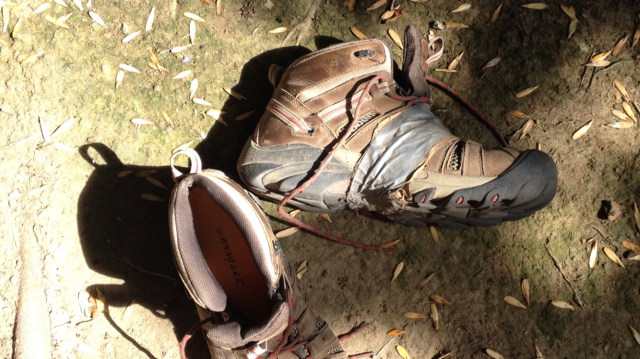
We were over 20 miles into a 50+ mile backpacking trip though the Golden Trout Wilderness in the High Sierras. With 35-40 pounds on our backs, we had completed the long, relentless slog up and over New Army Pass (12,300 feet) the day before, and somewhere on the backside of Guyot Pass (10,958 feet) my son, Seth, alerted me to a problem. My boot was coming apart.

I stared in disbelief. Clearly, the sole was detaching itself from the body of the boot, which seemed, upon reflection, sub-optimal to my purpose. I had come to climb Mt. Whitney—at 14,505 feet the highest peak in the contiguous United States—and the thought of doing so with half a left boot was untenable. As we tromped on, I kept rechecking the evidence (the way we do), as if on the fifth or eighth or tenth look I might discover that the previous nine had been an illusion. But a couple of dozen rechecks changed nothing. My foot was kaput.

When we set up camp in Upper Crabtree Meadow that evening, I considered my options, but not for long. The next day was Whitney, an all-day, 15-mile roundtrip requiring a 4,000-foot ascent, after which we would still be over 20 miles and three more mountain passes away from the trailhead. The manifest virtues of duct tape and hope (in that order) notwithstanding, the moment for prudence had clearly arrived. I tried to imagine it: Local Hiker Bags Whitney But Loses His Sole. With the welfare and safety of others directly affected by my actions, I just couldn’t take that chance.

There were 19 of us in total, six adults in various stages of middle-aged “fitness” along with 13 boys from 14 to 18 years old. I was by no means the leader of this expedition (outdoor competence being a necessary prerequisite), but I did feel responsible in a kind of paternal, ecclesiastical sense. And then of course there was Seth. Ten years ago I climbed Whitney with my oldest son, Luke, and while I can’t say that I relished the anticipation of the lung-shrinking climb to the summit, I did look forward to that trophy-shot of the two of us, hands on one another’s shoulders, the Sierra mountains stretching out behind us like a giant’s gnarled molars and bicuspids. Alas, it was not to be.

So the next morning the others began their climb to glory while I stayed behind supervising our campsite. I paced. I fidgeted. I fidgeted and paced. Anxiousness turned to worry as I tried to imagine my little group of intrepid alpinists. I knew, for example, that there are lightning showers every afternoon on Whitney, and if you don’t get off of the summit in time you may unwittingly become a Ben Franklin experiment. So you can imagine my state of mind as the hours passed and the afternoon rains came and my climbers were nowhere in sight. I quickly stowed our gear inside the tents, and then, with no other recourse available, I stowed myself inside as well, feeling helpless and useless as I imagined how I might report my experience later. (“How was your trip?” “In tents.”)

Seven hours. Eight hours. Nine hours passed. I lay in my tent, listening to the steady thrump of rain and praying for the safe return of my companions. Of my son. Finally, ten hours after their departure I heard the first voices. They straggled into camp, bedraggled and exhausted. Finally, over 11 hours after their 7am departure, the last of our group stumbled into camp.  I felt a surge of emotion that surprised me. We were safe. Together. At last.

I do not wish to overstate the significance of this experience for me. But I can tell you truthfully that what I felt that afternoon is not that different from the longing for togetherness—for homecoming—that I feel for you and every other member of the Santiago Creek Ward. I wait. Hoping to hear your voice. Praying for your safe return.

PW

How Things Work When They Don’t

antique-vacuum

Dear Will:

When it comes to home maintenance and repairs, I’m what they call in the trades Really Bad At It, or Utterly Useless, for short. You might recall, for example, how I somehow managed to destroy a fairly-new reverse-osmosis system while trying to fix a small leak under the kitchen sink. I could fill this page with other humiliating examples of my ineptitude, but let’s skip over that formality and go directly to this week’s confession: I’ve done it again. The legend continues.

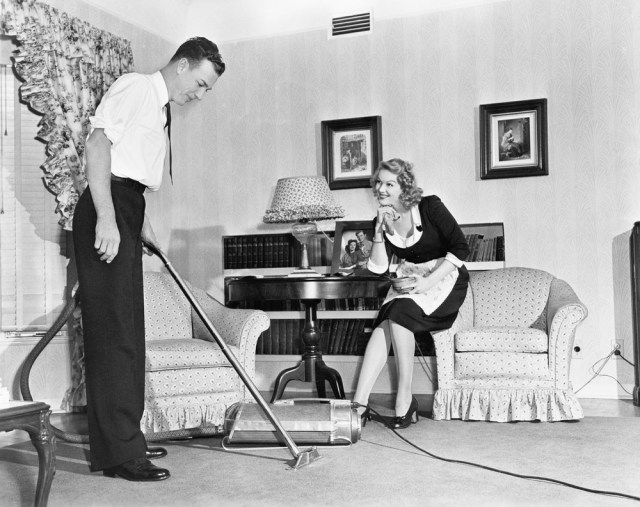
As always, it started out innocently enough: I was simply trying to do a little vacuuming—a low-skill assignment for which even I am qualified. I might even go so far as to claim a certain degree of competence in the field of Automated Dust Removal. But as I was maneuvering out into the upstairs hallway, I became aware that the family Hoover was no longer Hooving. “This thing sucks,” I hollered at my wife, Dana. “It’s supposed to,” she offered cheerfully. “It’s a vacuum cleaner.”

Diagnosing that there must be something obstructing the brush mechanism, I set about disassembling the intake unit. I figured I just had to remove a couple of screws, clear out the obstruction, and put the thing back together. I can work a screwdriver, I thought. How hard can it be? Right? Well, more than a dozen screws later, I finally had it opened.

It took me little time to clean out the brush and intake, but getting the base to snap back into place proved a little trickier—especially when I discovered that a small, metal bracket had joined the loose screws scattered about me. I knew where the bracket belonged, but getting it back into place appeared to defy several physical laws while tenaciously affirming the Second Law of Thermodynamics. Soon I looked like Jim wrestling a crocodile on Mutual of Omaha’s Wild Kingdom. And the croc was winning.

Well, of course I never got the thing back together (see: Thermodynamics, Second Law). Within an hour Dana and I were standing in the aisle at Costco pursuing the only sort of appliance repair that works consistently for me. And then, as fitting punctuation to an evening squandered, we spent most of the time at Costco fingering her iPad and ordering a new vacuum from Amazon instead.

The new machine (not a crocodile, but a Shark®) arrived a couple of days later. Seth offered to take Sharknado out on its maiden run, and when he was done we were shocked to see how much gunk it had managed to collect. Walking around the house afterward, we noted how different the carpet felt—like it was brand new. Hmmm. (Let that thought swirl around your head for a little bit.)

So it turns out the old Hoover really did suck, but unfortunately not in the manner that it was supposed to. Who knows how much grime has been accumulating over the past many months, or how long, for that matter, we had been shuffling around in it? Ewww. So in the end, my failed repair work may have been the best thing that has happened to our carpet since it was installed.

And thus emerges the familiar pattern in another embarrassing tale: Something goes wrong, and in my attempts to make it better I make it much, much worse. But in the end—somehow—I end up far better off than I could ever have been had disaster not struck to begin with. Happens all the time. I’m pretty sure Paul wasn’t thinking about carpet cleaning when he said that “all things work together for good to them that love God” (Romans 8:28), but on the other hand, isn’t it curious how much good comes from the bad stuff we unintentionally make worse? Interesting how that works. Carpet Diem!

PW

Government by the People

we-the-people

Dear Will:

When I was 19, I moved from Montevideo to Rio Branco, Uruguay, while serving a full-time LDS mission. I lived in an uninsulated, cinderblock apartment with a cold tile floor and a bathroom the size of a walk-in shower. In fact, the bathroom was a walk-in shower—exactly as nice as that sounds.

Just over the wall from Casa Frígida lived Doña Celia Terra, the beloved, local matriarch, who watched over and mothered us missionaries. A widow, Doña Celia lived with her adult son (let’s call him Jorge), who treated us with caution and respect. Only rarely would he enter a room with us present, however, and he never left the house. Not ever.

In time I learned that Jorge was not always the Boo Radley of Rio Branco. As best as I could tell with my still-fledgling Spanish, for some time Jorge had been a prisoner of the military leaders of Uruguay, who had seized control of the government a few years prior in an effort to put down a left-wing insurgency group called Los Tupamaros. Whether Jorge was actually affiliated with Los Tupamaros—and more to the point, whether he had actually done anything illegal—I never really knew. What I did know was that he had been tortured over the course of several years prior to his release, and he emerged from his captivity a severely broken man.

As you might guess, all of this was a bit hard for my 19-year-old brain to comprehend—especially in broken Spanish. Plus I knew next to nothing about Uruguayan politics and history. What made matters worse is that the mid-‘70s was an era in Uruguayan history that people were reluctant to talk about at any length. What was clear was that the citizens of Uruguay were deeply ashamed that their once-proud democracy had been transformed into a military dictatorship—this in a country which was once considered a model of stability and democracy, “The Switzerland of South America.”

Later that year, when I was once again living and working in the capital city of Montevideo, there was a widely publicized, constitutional referendum calling for a YES/NO vote. Once again, I understood very little of what was taking place, but the vast majority of the impossible-to-ignore advertising was in support of the proposal. With virtually no discernible campaign to convince people to vote NO, I assumed that the referendum would pass in a landslide.

At last, on November 30, 1980, over 86% of eligible voters cast ballots as required by law. To my utter astonishment, the referendum was soundly defeated, with over 57% voting against it. It seemed impossible. It was only later that I learned that the purpose of the referendum was to legalize in a new constitution the military control of government that so many Uruguayans found so appalling.

It was a remarkable day in the history of democracy—remarkable (to be fair) that the military allowed the vote to begin with, and remarkable that so many were able to see through prevailing propaganda to reaffirm “government by the people” in keeping with established constitutional law. For me it was also the most powerful example I have witnessed of a the truth taught in the Book of Mormon: “Now it is not common that the voice of the people desireth anything contrary to that which is right” (Mosiah 29:26).

As we face an election of our own in the days and months ahead, I invite you to ponder that truism and the obligation it implies. Regardless of where you fall on the political spectrum, let your voice be heard. Truth and right will win out so long as good people refuse to sit idly by. Please vote.

PW