Breakfast for Dinner

IMG_1234

Dear Will:

The thing about pancakes is that you get to douse them with syrup. Goopy, sweet, and delicious, syrup is one of the great nectars of childhood. Remember when you first discovered that—even though they were super-indulgent, dessert-like wonders—pancakes were a featured item of the Most Important Meal of the Day? Talk about beating the system! You would look at your siblings incredulously, blinking in amazement as if to say “Can you believe this?” in some sort of eyelash-flapping Morse code.

When I was growing up, I probably ate pancakes at least once a week. My mother would fry up a pound of bacon, cook a dozen or so eggs, and throw in the flapjacks just for good measure. It was both wonderful and no big deal. But then some fool invented cholesterol and spoiled an otherwise great thing for generations of kids to come. Add in the complications of over-programmed childhoods and it’s perhaps easy to understand why, one generation later, my children have pretty much subsisted on Cheerios and Quaker Oatmeal Squares for breakfast throughout their lives. It hardly seems fair.

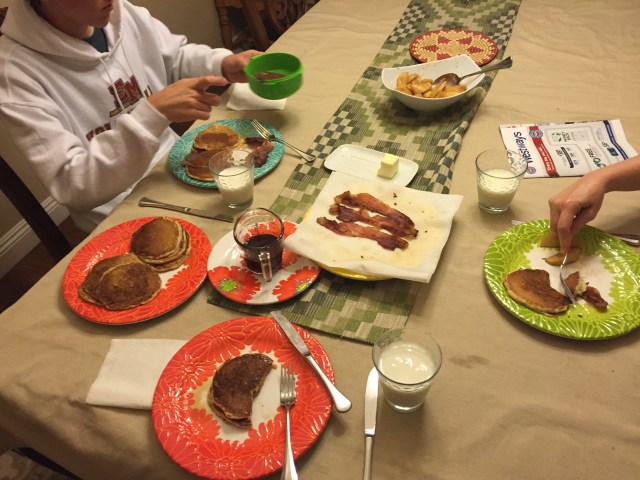
So in order to assuage my guilt and keep them from reporting me to authorities, when they were small I began the practice of making Special Breakfast on Sunday mornings. It was an important bonding ritual for me and my kids since my wife, Dana—who has never been much of a breakfast-eater—was rarely around to cast a disapproving motherly glare at our mounds of goopy goodness. Guilt-free and giddy, we would slather and stab, forkful upon sticky forkful, unconcerned with caloric intake or the latest in nutritional science. And for one hour each week, I got to be the cool parent while eating breakfast the way it was meant to be eaten.

As a consequence, my kids and I have come to take our pancakes very seriously. We don’t use Bisquick (please) or Krusteaz (don’t insult me) or any other variety of ready-made mixes. As for me and my house, pancakes are strictly from scratch, with real buttermilk and a variety of other not-very-secret ingredients that, over the years, have turned the basic recipe from The Joy of Cooking into my own signature line against which my children judge all other so-called hotcakes. Straight from the griddle, we smear them with butter and genuine maple or homemade apple syrup. If Dana is around we’ll throw in a few blueberries so that perhaps she’ll cave in and join us.

Or at least, that’s what we used to do. These days, I’m in meetings from early to late most Sundays, and I get through the day without any breakfast, Special or otherwise. For his part, like any good teenager, Seth (the only kid left at home) would rather sleep in till noon if given the choice, so as with so many other essential family rituals, Special Breakfast now happens only once or twice a year. It’s just not the same. We’ve lost something important—and it’s not (I hasten to add) weight.

So with Dana’s complete (if unenthusiastic) acquiescence—we have declared that tonight shall be Breakfast for Dinner, an indulgent shout-out to years gone by when calories didn’t count and it was still possible for Dad to be cool.

And in so doing, we shall feel virtuous because we are fulfilling a mandate given by prophets of God, who said (and I quote): “Successful marriages and families are established and maintained on principles of faith, prayer, repentance, forgiveness, respect, love, compassion, work, wholesome recreational activities . . . and pancakes.” At least, I’m pretty sure that’s what they said. And if not, surely it’s what they meant.

PW

Please Don’t Tell the Ranger

IMG_1224

Dear Will:

“WARNING!,” the notice read. “EXTREME ALPINE CONDITIONS. The following MINIMUM equipment, experience, procedures and skills strongly recommended by the US Forest Service and County Sheriff’s Department Search & Rescue Teams.” The list included winter mountaineering training, map, ice axes, helmets, alpine boots, and crampons.

We had none of that. But when you agree to go hiking with Bryn, that sort of lack of preparation does not register even as a minor annoyance. “It’ll be fine,” she insisted. “Let’s do it.”

I suppose this is what I unwittingly signed up for 21 years ago when she was born, but it would have been nice in that moment to have come prepared with a suitably exotic Plan B that might have dissuaded her from her purpose. But here’s the thing: Her original intention was to climb Mt. San Gorgonio—alone—at night—so that she could be on the summit at sunrise. That we were intending to climb Mt. San Bernardino in the daytime was Plan B.

How often have we read about people who disregard expert advice and common sense and venture off where they do not belong, only to be airlifted to the hospital to have their frostbitten toes surgically removed? That was about to be us. Or to be more specific: me. Bryn is a fit and fearless dancer and world traveler. I spend my days building PowerPoint decks and hiking to the Men’s Room.

We weren’t even a third of the way to the 10,700-foot summit when the trail became mostly covered in icy snow. We had to rely on the footsteps of previous hikers to mark the way—footsteps gouged with the unmistakable stab-marks of crampons, I might add. It was about that time that we came upon another hiker—decked out in the sort of regalia that would have filled the Ranger with a frisson of joy—who had turned back, she said, because of faulty footwear. It was like one of those allegories you hear in Sunday School about the angel who comes along to warn the unsuspecting of imminent disaster.

(You saw this coming): Nevertheless, we hiked on. On one particularly treacherous side-slope I remember thinking that if I slipped I could very well end up luging all the way to Yucaipa—unless, that is,  I could MacGyver a handbrake out of my ChapStick and a protein bar. Fortunately for me (and my ChapStick) it never came to that. The first time I took a spill was while trying to cross a bunch of manzanita, so rather than becoming a human toboggan I merely sustained a puncture wound to the shoulder and several other bloody scrapes along my left side. That I could handle.

Eventually we lost the trail altogether. We made an earnest attempt to connect up with a different set of footprints in an adjacent gully, but the hiking there proved to be the most taxing of the entire adventure. When we could no longer confidently identify the peak we were supposedly climbing, the following words of Robert Frost passed through my mind:

I shall be telling this with a sigh
Somewhere ages and ages hence:
Two roads diverged in a wood, and I—
I took the one less traveled by,
And they never found my body.

Actually, I’m not sure about that closing line, but I guarantee you my friends would have paid a lot more attention in English class if Frost had written it that way. As it was, I knew that, although I had not reached the summit, I had reached my limit. I begged Bryn for mercy.

Reluctantly, she relented. We had fallen 1000 feet short of our goal, just as (apparently) others had before us. Now the only trick was to retrace our steps. I will skip the humiliating story of the spill I took on the way down that turned my sunglasses into safety goggles and my nose and forehead into hamburger. And on one other detail I will be appropriately brief: We spent most of the day hiking in sunshine across bright, white snow. We carried sunscreen every step of the way. We forgot to use it.

In all we covered over 16 miles of mountain on a difficult yet glorious day. And while my sunburned face seems to be decomposing like something out of that scene at the end of Raiders of the Lost Ark, I have it on good authority that the damage is not likely to be permanent. Except maybe for that gash on the bridge of my nose.

So what’s my point? I suppose that, in the spirit of Choose Your Own Adventure, you might select from any of these familiar aphorisms:

  1. It’s not about the destination. It’s about the near-death experiences along the journey.
  2. That which doesn’t kill you makes you stronger—unless you forget the sunscreen.
  3. A journey of 1000 miles begins with the proper equipment.
  4. Nothing ventured, nothing broken.
  5. Just because you got away with it, doesn’t mean you’re not stupid.

To which I would add one other: It’s pretty great to be a dad.

PW

That He May Heal You

2011-10-055-the-prodigal-son-1920x960

“Surely the thing God enjoys most about being God
is the thrill of being merciful,
especially to those who don’t expect it
and often feel they don’t deserve it.”
Elder Jeffrey R Holland

Dear Will:

We’re not really sure why he left. Maybe he thought the old man was too far past his prime to run the place. Maybe somebody said something that made him mad or hurt his feelings. Perhaps he was simply tired of being weighed down by high expectations, of having to live a certain way or having to be a certain kind of guy. Or maybe he just no longer believed in what he was doing anymore.

But for whatever reason, he finally walked away, leaving behind the only life he had ever known and all of the advantages and privileges that came with it. Forsaking the promise of a too-far-distant reward, he cashed in his inheritance and entered the enticing world of “anything goes”—where he could do or be whatever he wanted and no one would be standing by to raise an eyebrow or to sharply remind him of how his choices might besmirch the family name. Thus liberated from obligations and responsibility, he experimented, indulged, spent time and money as he never had before, did things he had been taught he should not do. And all too quickly, the inheritance ran out, “wasted,” we are told, “with riotous living.”

And then, as so often happens in life, extraneous circumstance complicated the natural consequences of choice. Famine brought widespread economic hardship, so that when he had spent every last penny and found himself compelled to look for work, there were no good jobs to be found. Ere long, he who was born to privilege, and had but recently enjoyed some degree of personal wealth, found himself settling for what work he could get. So it was that he was hired on as a farm laborer, assigned (one suspects, with some degree of horror) to feed the hogs—unclean beasts according to the religion of his youth.

Close your eyes and it’s easy to imagine him sloshing about his daily chores, nostrils filled with the foulest of stenches, boots covered in unspeakable muck, doling out table scraps to the swine while his own belly remained unfilled. The humiliation of it must have been soul-crushing. Hungry, ashamed, brokenhearted and contrite, he reached such a lowly state that he finally “came to himself,” and in a moment of clarity recognized a potential way out.

Was it possible, he wondered, to ask his father for a job? His father’s servants always had food in their stomachs, didn’t they? And you could be sure that no one in his father’s employ would be asked to slop the hogs. But could he truly go home again after what he had done? Could he ever be forgiven for his foolish choices, his hubris, his transgressions against the family name?

Although he must have felt unbearable emotional anguish, his physical hunger was even greater. Desperate, willing to do anything to reclaim his broken life, he quit his job, put on the best of his tattered and splattered clothes, and began the long walk home.

As he walked, no doubt he rehearsed and re-rehearsed the words that he would speak when he finally arrived back on his father’s doorstep. He would acknowledge his transgressions against God and family and beg forgiveness. He would pledge renewed faithfulness and hard work. He would disavow his vices and welcome whatever conditions might be placed upon him if only he might be granted the lowliest assignment, the most meager of wages, among his father’s group of servants.

His father, in turn, would be fully justified if he ranted a bit, lectured sternly, questioned his son’s judgment, and lamented the tragic waste of time and money and opportunity. What’s more, there might be a time of agonizing uncertainty while his father paced and raged, leaving his wayward son to feel the full extent of a parent’s disappointment. But the young man would willingly endure all of that and more because he felt that he deserved it—and, let’s be honest: He had nowhere else to turn.

Were this a true-life story, that might be exactly how it played out. But this is an allegory, originally told by the Master Teacher who had a different lesson in mind. The ultimate message in this story is less about disobedience and repentance than it is about love and forgiveness and reconciliation. Jesus tells it this way:

    And he arose, and came to his father. But when he was yet a great way off, his father saw him, and had compassion, and ran, and fell on his neck, and kissed him.
    And the son said unto him, Father, I have sinned against heaven, and in thy sight, and am no more worthy to be called thy son.
    But the father said to his servants, Bring forth the best robe, and put it on him; and put a ring on his hand, and shoes on his feet:
    And bring hither the fatted calf, and kill it; and let us eat, and be merry:
    For this my son was dead, and is alive again; he was lost, and is found. . . . (Luke 15:20-24)

As you envision that scene, please notice how the moment of reconciliation plays out. The father in this tale does not stand proudly in front of his house, forcing his despondent son to complete the long, difficult walk home alone. Rather, when the son is still “a great way off,” the father in this case runs to him, literally shortening the journey back to family and fellowship. As soon as the son has finished his sincere expression of regret, the father envelops him in love and security—restoring the benefits and honor set aside for his children. The natural consequences of the son’s choices have apparently been punishment enough, so that rather than castigate the prodigal for his wastrel ways, the father instead focuses on celebrating his return.

At its very core, the story of the Prodigal Son is the story of the Gospel of Jesus Christ. Its promise is intended to fill all of us with hope that, no matter what we may have done and no matter why we may have done it, we can all “come to ourselves” and turn back toward our Father, who will certainly run to us, accept our contrition and make us whole once again. In the Book of Mormon He says it this way: “Will ye not now return unto me, and repent of your sins, and be converted, that I may heal you?” (3 Nephi 9:13).

That invitation extends to all of us. Who among us has not found him or herself in a similar, lowly state? Who hasn’t at some point made regrettable choices that have caused us to drift ever farther from our Heavenly Father? Even if we may not have been as willful as the prodigal in this story, we can certainly relate to his state of regret and longing for home. Whether we have walked away literally or figuratively, we certainly know what it’s like to feel cut off, wrung out, desperate for help we may feel unworthy to ask for.

It’s true that we do not know why the Prodigal Son wandered off. But ultimately it doesn’t matter. Whether someone has hurt your feelings, or you’re tired of the Gospel’s high expectations, or you have made unwise choices, or you resent the Church’s lofty standards, or you have lost your faith in those in charge, or you’re simply not sure what you believe anymore, may I invite you to turn back toward home? Whatever might be your current source of pain and longing and disaffection, return unto the Savior that He may heal you. Reclaim your divine inheritance which—no matter what choices you may have made or may yet make—will never be fully spent.

I express my own faith in the promise of the Gospel of Jesus Christ and in the healing power of His Atonement. As one who is also prone to wander, I am well familiar with the long road home. Come. Let’s walk that road together.

PW