How Things Work When They Don’t

antique-vacuum

Dear Will:

When it comes to home maintenance and repairs, I’m what they call in the trades Really Bad At It, or Utterly Useless, for short. You might recall, for example, how I somehow managed to destroy a fairly-new reverse-osmosis system while trying to fix a small leak under the kitchen sink. I could fill this page with other humiliating examples of my ineptitude, but let’s skip over that formality and go directly to this week’s confession: I’ve done it again. The legend continues.

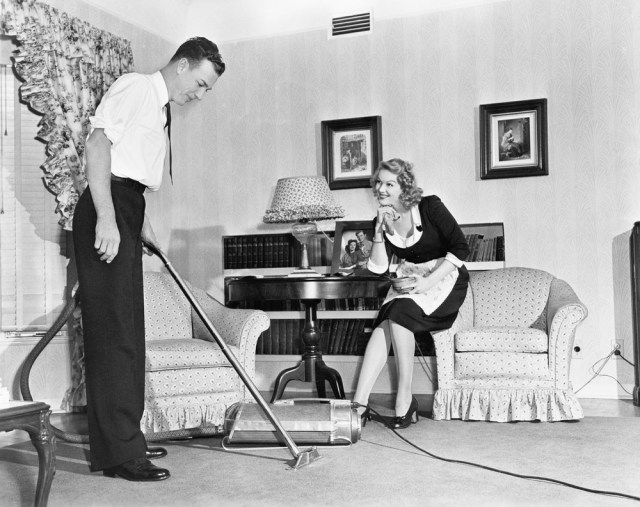
As always, it started out innocently enough: I was simply trying to do a little vacuuming—a low-skill assignment for which even I am qualified. I might even go so far as to claim a certain degree of competence in the field of Automated Dust Removal. But as I was maneuvering out into the upstairs hallway, I became aware that the family Hoover was no longer Hooving. “This thing sucks,” I hollered at my wife, Dana. “It’s supposed to,” she offered cheerfully. “It’s a vacuum cleaner.”

Diagnosing that there must be something obstructing the brush mechanism, I set about disassembling the intake unit. I figured I just had to remove a couple of screws, clear out the obstruction, and put the thing back together. I can work a screwdriver, I thought. How hard can it be? Right? Well, more than a dozen screws later, I finally had it opened.

It took me little time to clean out the brush and intake, but getting the base to snap back into place proved a little trickier—especially when I discovered that a small, metal bracket had joined the loose screws scattered about me. I knew where the bracket belonged, but getting it back into place appeared to defy several physical laws while tenaciously affirming the Second Law of Thermodynamics. Soon I looked like Jim wrestling a crocodile on Mutual of Omaha’s Wild Kingdom. And the croc was winning.

Well, of course I never got the thing back together (see: Thermodynamics, Second Law). Within an hour Dana and I were standing in the aisle at Costco pursuing the only sort of appliance repair that works consistently for me. And then, as fitting punctuation to an evening squandered, we spent most of the time at Costco fingering her iPad and ordering a new vacuum from Amazon instead.

The new machine (not a crocodile, but a Shark®) arrived a couple of days later. Seth offered to take Sharknado out on its maiden run, and when he was done we were shocked to see how much gunk it had managed to collect. Walking around the house afterward, we noted how different the carpet felt—like it was brand new. Hmmm. (Let that thought swirl around your head for a little bit.)

So it turns out the old Hoover really did suck, but unfortunately not in the manner that it was supposed to. Who knows how much grime has been accumulating over the past many months, or how long, for that matter, we had been shuffling around in it? Ewww. So in the end, my failed repair work may have been the best thing that has happened to our carpet since it was installed.

And thus emerges the familiar pattern in another embarrassing tale: Something goes wrong, and in my attempts to make it better I make it much, much worse. But in the end—somehow—I end up far better off than I could ever have been had disaster not struck to begin with. Happens all the time. I’m pretty sure Paul wasn’t thinking about carpet cleaning when he said that “all things work together for good to them that love God” (Romans 8:28), but on the other hand, isn’t it curious how much good comes from the bad stuff we unintentionally make worse? Interesting how that works. Carpet Diem!

PW

Government by the People

we-the-people

Dear Will:

When I was 19, I moved from Montevideo to Rio Branco, Uruguay, while serving a full-time LDS mission. I lived in an uninsulated, cinderblock apartment with a cold tile floor and a bathroom the size of a walk-in shower. In fact, the bathroom was a walk-in shower—exactly as nice as that sounds.

Just over the wall from Casa Frígida lived Doña Celia Terra, the beloved, local matriarch, who watched over and mothered us missionaries. A widow, Doña Celia lived with her adult son (let’s call him Jorge), who treated us with caution and respect. Only rarely would he enter a room with us present, however, and he never left the house. Not ever.

In time I learned that Jorge was not always the Boo Radley of Rio Branco. As best as I could tell with my still-fledgling Spanish, for some time Jorge had been a prisoner of the military leaders of Uruguay, who had seized control of the government a few years prior in an effort to put down a left-wing insurgency group called Los Tupamaros. Whether Jorge was actually affiliated with Los Tupamaros—and more to the point, whether he had actually done anything illegal—I never really knew. What I did know was that he had been tortured over the course of several years prior to his release, and he emerged from his captivity a severely broken man.

As you might guess, all of this was a bit hard for my 19-year-old brain to comprehend—especially in broken Spanish. Plus I knew next to nothing about Uruguayan politics and history. What made matters worse is that the mid-‘70s was an era in Uruguayan history that people were reluctant to talk about at any length. What was clear was that the citizens of Uruguay were deeply ashamed that their once-proud democracy had been transformed into a military dictatorship—this in a country which was once considered a model of stability and democracy, “The Switzerland of South America.”

Later that year, when I was once again living and working in the capital city of Montevideo, there was a widely publicized, constitutional referendum calling for a YES/NO vote. Once again, I understood very little of what was taking place, but the vast majority of the impossible-to-ignore advertising was in support of the proposal. With virtually no discernible campaign to convince people to vote NO, I assumed that the referendum would pass in a landslide.

At last, on November 30, 1980, over 86% of eligible voters cast ballots as required by law. To my utter astonishment, the referendum was soundly defeated, with over 57% voting against it. It seemed impossible. It was only later that I learned that the purpose of the referendum was to legalize in a new constitution the military control of government that so many Uruguayans found so appalling.

It was a remarkable day in the history of democracy—remarkable (to be fair) that the military allowed the vote to begin with, and remarkable that so many were able to see through prevailing propaganda to reaffirm “government by the people” in keeping with established constitutional law. For me it was also the most powerful example I have witnessed of a the truth taught in the Book of Mormon: “Now it is not common that the voice of the people desireth anything contrary to that which is right” (Mosiah 29:26).

As we face an election of our own in the days and months ahead, I invite you to ponder that truism and the obligation it implies. Regardless of where you fall on the political spectrum, let your voice be heard. Truth and right will win out so long as good people refuse to sit idly by. Please vote.

PW

Breakfast for Dinner

IMG_1234

Dear Will:

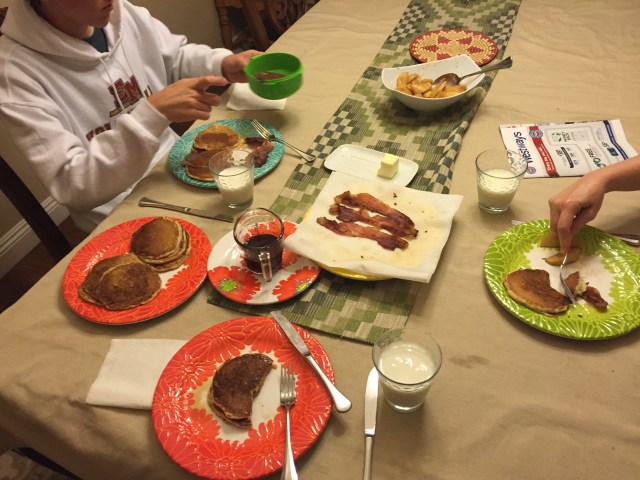
The thing about pancakes is that you get to douse them with syrup. Goopy, sweet, and delicious, syrup is one of the great nectars of childhood. Remember when you first discovered that—even though they were super-indulgent, dessert-like wonders—pancakes were a featured item of the Most Important Meal of the Day? Talk about beating the system! You would look at your siblings incredulously, blinking in amazement as if to say “Can you believe this?” in some sort of eyelash-flapping Morse code.

When I was growing up, I probably ate pancakes at least once a week. My mother would fry up a pound of bacon, cook a dozen or so eggs, and throw in the flapjacks just for good measure. It was both wonderful and no big deal. But then some fool invented cholesterol and spoiled an otherwise great thing for generations of kids to come. Add in the complications of over-programmed childhoods and it’s perhaps easy to understand why, one generation later, my children have pretty much subsisted on Cheerios and Quaker Oatmeal Squares for breakfast throughout their lives. It hardly seems fair.

So in order to assuage my guilt and keep them from reporting me to authorities, when they were small I began the practice of making Special Breakfast on Sunday mornings. It was an important bonding ritual for me and my kids since my wife, Dana—who has never been much of a breakfast-eater—was rarely around to cast a disapproving motherly glare at our mounds of goopy goodness. Guilt-free and giddy, we would slather and stab, forkful upon sticky forkful, unconcerned with caloric intake or the latest in nutritional science. And for one hour each week, I got to be the cool parent while eating breakfast the way it was meant to be eaten.

As a consequence, my kids and I have come to take our pancakes very seriously. We don’t use Bisquick (please) or Krusteaz (don’t insult me) or any other variety of ready-made mixes. As for me and my house, pancakes are strictly from scratch, with real buttermilk and a variety of other not-very-secret ingredients that, over the years, have turned the basic recipe from The Joy of Cooking into my own signature line against which my children judge all other so-called hotcakes. Straight from the griddle, we smear them with butter and genuine maple or homemade apple syrup. If Dana is around we’ll throw in a few blueberries so that perhaps she’ll cave in and join us.

Or at least, that’s what we used to do. These days, I’m in meetings from early to late most Sundays, and I get through the day without any breakfast, Special or otherwise. For his part, like any good teenager, Seth (the only kid left at home) would rather sleep in till noon if given the choice, so as with so many other essential family rituals, Special Breakfast now happens only once or twice a year. It’s just not the same. We’ve lost something important—and it’s not (I hasten to add) weight.

So with Dana’s complete (if unenthusiastic) acquiescence—we have declared that tonight shall be Breakfast for Dinner, an indulgent shout-out to years gone by when calories didn’t count and it was still possible for Dad to be cool.

And in so doing, we shall feel virtuous because we are fulfilling a mandate given by prophets of God, who said (and I quote): “Successful marriages and families are established and maintained on principles of faith, prayer, repentance, forgiveness, respect, love, compassion, work, wholesome recreational activities . . . and pancakes.” At least, I’m pretty sure that’s what they said. And if not, surely it’s what they meant.

PW