In Over Our Heads

Dear Will:

Over the course of my lifetime, I have been accused of many things, but I can unequivocally affirm that not once have I been accused of being a wiz with finances. That I have made it through this many years of life and still remain solvent is a mystery unlikely to be solved by dozens of forensic accountants working round the clock for years on end. And yet the fact remains: In spite of a long history of dubious choices over the course of many years, I have somehow, some way, managed to reach my 64th year debt-free. In December we even paid off our house.

That was no small feat considering that when we bought the place we had no clear understanding of how mortgages work. We refinanced this house a number of times, sometimes withdrawing some equity to pay off other things along the way, before fully realizing that we were dialing our 30-year mortgage back to the beginning each time—and meanwhile, what we owed was growing, not shrinking. (Seems obvious enough, but, well, see paragraph one.) Once we made the shocking discovery that we were kind of moving backwards, we were forced to convert to a 15-year loan in order to get ourselves more or less back on track. We were perhaps the only kids in the neighborhood who more than once managed to secure a lower interest rate and still end up with a higher monthly payment. Dumb. 

My latest genius move came a couple of years ago when we installed solar panels on top of a 35-year-old roof.  Any B-average fifth-grader could have anticipated the problem with that choice, but since I didn’t have one handy to advise me, I went on ahead with the plan. The panels have worked out great, but the atmospheric rivers of 2024 have revealed that our original-equipment roof is finally kaput. Which of course will require that the panels be removed ($) and then reinstalled ($) on top of an all-new rooftop ($$$$). Really dumb.

How is it, then, that my manifest incompetence notwithstanding, I own a reasonably nice home in a very nice neighborhood in Southern California? That I’m bumbling toward retirement with a decent balance in my 401(k) plan and some additional investments besides? How is that even possible? I was born with a tailwind, of course. Heritage and opportunity (and whole lot of dumb luck) have been major contributors, but there are a couple of other factors that I must acknowledge as well:

1) Dana and I have gotten some assistance from our parents from time to time along the way. They have helped bridge some tough circumstances in our early years (unemployment: not recommended, FYI) and in later years have bolstered our savings as well. We are quick to acknowledge that not everyone has that kind of generous, loving backup system.

2) We have always—even in the down times—faithfully paid tithes and offerings, gratefully giving while embracing with faith the promises laid out by both Isaiah and Malachi. Those promises do not give us any assurance of wealth, prosperity—or even solvency—but we have always believed that if we willingly give back, sharing whatever bounty we may have, everything is going to work out in the end. 

In the most recent General Conference for our church, Elder Gerrit W. Gong gave an address that captures what I’m feeling even as I await the roofer’s estimate. He shared a Chinese story about a man whose son finds a beautiful horse:

“How fortunate,” the neighbors say. “We’ll see,” says the man.

Then the son falls off the horse and is permanently injured. “How unfortunate,” the neighbors say. “We’ll see,” says the man.

A conscripting army comes but doesn’t take the injured son. “How fortunate,” the neighbors say. “We’ll see,” says the man.

Elder Gong then gave this important reminder: “This fickle world often feels tempest tossed, uncertain, sometimes fortunate, and—too often—unfortunate. Yet, in this world of tribulation, ‘we know that all things work together for good to them that love God’ (Romans 8:28).”

Our race is not yet run. Dana and I could live another 30 years, and who knows what potholes and pitfalls may await us in the road ahead? Will our savings be enough to get us from here to there? We shall see. But we have already been blessed far beyond our merits. And we live with the ongoing assurance that, come what may, all things will work together for our good.

Our leaky roof notwithstanding.

PW

Photo by Annie Spratt on Unsplash

Dirt Rich

Dear Will:

You could have called them a bunch of dirt farmers and you wouldn’t have been far from wrong. At the end of the 19th century, dirt was about all you would have found in that part of the Big Horn Basin. That, and maybe enough sagebrush to support a couple of scrawny cattle. Maybe that, but not much more. However, if you were a child, newly arrived from Morgan, Utah, peeking out of a tent at that patch of nearly-nothing, perhaps what you would have seen was an endless horizon, full of promise, stretching west to a tomorrow so brimming with life that only a child could have believed it possible.

My grandfather, Lloyd Taggart, was that kid. Only nine at the time, he was sent with his parents and siblings and maybe 200 others to establish a so-called “Mormon colony” in northern Wyoming. In that mix was an eight-year-old charmer named Louise Welch. Over time, love grew where perhaps crops could not, and by 1916 the two were married, united in their commitment to build a life together in the Big Horn. Raised by family-first pioneers, Lloyd and Louise before long had a brood of their own, with nine kids crammed (somehow) into a two-bedroom home in Cowley, a town built on such prime real estate that to this day its population has never topped 1,000—even if you include those scrawny cows.

I don’t mean to pick on Cowley. My mother was born in that two-bedroom sardine can, and her eyes would twinkle when she remembered the place. The point is that Lloyd and Louise didn’t exactly get a running start in this three-legged race of theirs. But when they settled, at last, in nearby Cody, the two of them established a presence there that from my distant perspective seems incomprehensibly larger than life. Lloyd built a hugely successful construction company that laid down roads throughout the state, including, most notably, in and around Yellowstone Park. Louise, meanwhile, was an originating member of Cody Play Readers and of the Cody Music Club which, I’m stupefied to report, is still around today. And somehow in the midst of all that they acquired and ran the Two Dot, a 170,000-acre cattle ranch north of Cody on Pat O’Hara Creek (you know the place). All that—and so much more that you wouldn’t even believe a fraction of it—while raising those nine precocious kids.

How does that happen? How do two pioneer kids go from next-to-nothing to something-almost-unimaginable? You can bet that grit and industry were big contributors, but I have a hunch that more than a little of their ultimate prosperity and happiness sprang from their loving partnership, built upon a sure foundation of faith in God. You see what needs to be done and get busy doing it, day after day until your legs ache and your back buckles and all you have left at sundown is the strength to fall to your knees and thank your Maker for being part of it all. “Seek ye first the kingdom of God and his righteousness,” said Jesus, “and all these things shall be added unto you” (Matthew 6:33). That’s not a surefire guarantee of success, but I believe it is a promise that when you put first things first, you somehow find a way. Paul said as much: “All things work together for the good to them that love God” (Romans 8:28).

Thus when your church asks you to start over on a dusty, waterless plain, you do it. And when that same church asks you to preside over a fledgling flock of believers—for over 29 uninterrupted years—even though you’re trying to build a construction company and run a cattle ranch and help build a hospital and a bank and serve on the boards of a variety of local businesses . . . (hang on . . . gotta catch my breath) . . . well, you do it is what you do. And all the while, you follow that ancient credo: “Trust in the Lord with all thine heart; and lean not unto thine own understanding. In all thy ways acknowledge him, and he shall direct thy paths” (Proverbs 3:5-6). And thus—somehow—it works out.

I suppose that what I’m saying is that, if you should ever feel like your life has been dumped and scattered, leaving you to more or less start over without much more than a canvas tent to your good name, perhaps you should invite God to look over your shoulder as you to peek out of the tent-flap at the horizon ahead. There’s no telling what you might see. Nor what you might accomplish together.

PW

P.S. My grandmother, Louise Welch, is the taller girl on the right, standing between her father and the horse. I told you she was a charmer.

How Things Work When They Don’t

antique-vacuum

Dear Will:

When it comes to home maintenance and repairs, I’m what they call in the trades Really Bad At It, or Utterly Useless, for short. You might recall, for example, how I somehow managed to destroy a fairly-new reverse-osmosis system while trying to fix a small leak under the kitchen sink. I could fill this page with other humiliating examples of my ineptitude, but let’s skip over that formality and go directly to this week’s confession: I’ve done it again. The legend continues.

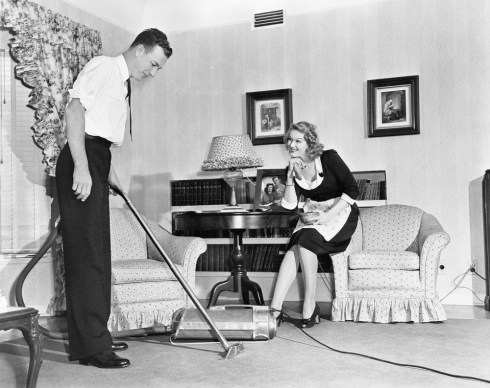
As always, it started out innocently enough: I was simply trying to do a little vacuuming—a low-skill assignment for which even I am qualified. I might even go so far as to claim a certain degree of competence in the field of Automated Dust Removal. But as I was maneuvering out into the upstairs hallway, I became aware that the family Hoover was no longer Hooving. “This thing sucks,” I hollered at my wife, Dana. “It’s supposed to,” she offered cheerfully. “It’s a vacuum cleaner.”

Diagnosing that there must be something obstructing the brush mechanism, I set about disassembling the intake unit. I figured I just had to remove a couple of screws, clear out the obstruction, and put the thing back together. I can work a screwdriver, I thought. How hard can it be? Right? Well, more than a dozen screws later, I finally had it opened.

It took me little time to clean out the brush and intake, but getting the base to snap back into place proved a little trickier—especially when I discovered that a small, metal bracket had joined the loose screws scattered about me. I knew where the bracket belonged, but getting it back into place appeared to defy several physical laws while tenaciously affirming the Second Law of Thermodynamics. Soon I looked like Jim wrestling a crocodile on Mutual of Omaha’s Wild Kingdom. And the croc was winning.

Well, of course I never got the thing back together (see: Thermodynamics, Second Law). Within an hour Dana and I were standing in the aisle at Costco pursuing the only sort of appliance repair that works consistently for me. And then, as fitting punctuation to an evening squandered, we spent most of the time at Costco fingering her iPad and ordering a new vacuum from Amazon instead.

The new machine (not a crocodile, but a Shark®) arrived a couple of days later. Seth offered to take Sharknado out on its maiden run, and when he was done we were shocked to see how much gunk it had managed to collect. Walking around the house afterward, we noted how different the carpet felt—like it was brand new. Hmmm. (Let that thought swirl around your head for a little bit.)

So it turns out the old Hoover really did suck, but unfortunately not in the manner that it was supposed to. Who knows how much grime has been accumulating over the past many months, or how long, for that matter, we had been shuffling around in it? Ewww. So in the end, my failed repair work may have been the best thing that has happened to our carpet since it was installed.

And thus emerges the familiar pattern in another embarrassing tale: Something goes wrong, and in my attempts to make it better I make it much, much worse. But in the end—somehow—I end up far better off than I could ever have been had disaster not struck to begin with. Happens all the time. I’m pretty sure Paul wasn’t thinking about carpet cleaning when he said that “all things work together for good to them that love God” (Romans 8:28), but on the other hand, isn’t it curious how much good comes from the bad stuff we unintentionally make worse? Interesting how that works. Carpet Diem!

PW