Dear Will:
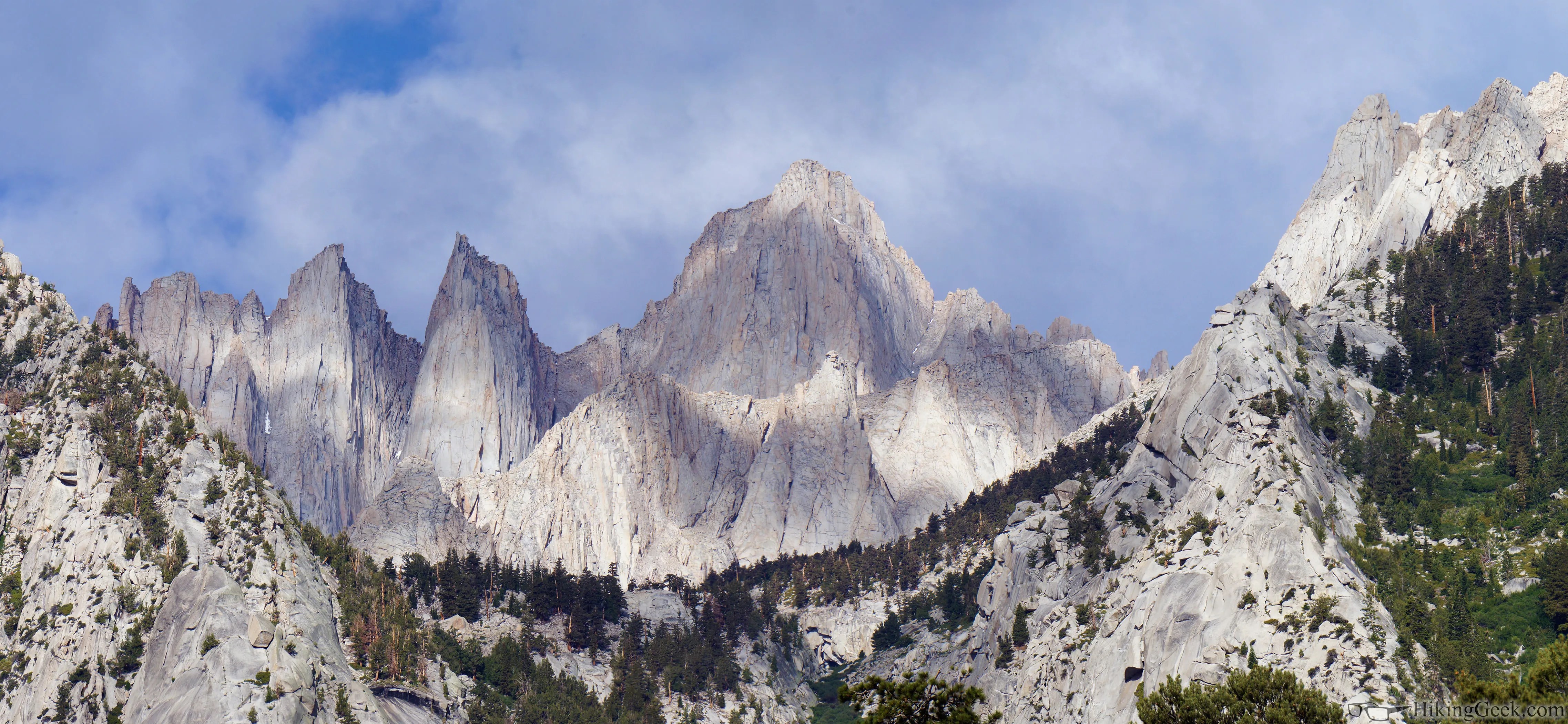
I know it doesn’t seem possible, but I’m pretty sure my hair hurts. My earlobes throb and my toenails are cramping. Even my freckles are in pain. That’s what happens, you know, when you ignore the realities of middle age and decide—who knows why?—that you will climb Mt. Whitney. That’s right: Mt. Whitney, the highest peak in the lower 48 states, 14,505 feet above sea level. It’s not exactly a walk in the park, as they say—at least, not any park I have ever been to before.
Think of it this way: Say you start your climb (as just about everyone does) at the Whitney Portal, a mere 8,300 feet up. From there, it’s 11 miles to the summit, uphill as it turns out (who knew?). What you’ll notice as you make the ascent is that somewhere around 10,000 feet the trees pretty much give up and go home. The oxygen loses quite a bit of interest as well. So after hiking six miles with a 35-pound pack and spending the night around 12,000 feet to acclimate yourself, you will finish the climb surrounded by nothing but boulders, a few hearty wildflowers (how is that possible?), and other morons who are trudging up the hill simply because, like you, they had a few free hours and somehow it seemed like a good idea.
If you’ve never hung around at that altitude, you can’t begin to appreciate the air you’re breathing right now. During the final five miles of our climb, I was out of breath constantly. Now I’m the first to admit that in my present physical condition I can get winded navigating the produce section at Ralph’s, but even so, this hike was different. By the end, I was barely shuffling along, concentrating on every breath in the vain attempt to give my lungs the oxygen they craved.
In our little group of 11, seven of us (four teens and three adults) made it to the summit. I confess that my reaction was more relief than elation, however, because the climb was such an ordeal. Little did I know, however, that the ordeal was just beginning.
Upon arriving at the mountain-top, one member of our group started suffering from altitude sickness, which is a polite way to say that he threw up. Repeatedly. For the entire 5-mile descent to our base camp. The poor guy was unable to eat or drink anything without, shall we say, gastric emanations. With no fuel in his body, he had a very hard time getting down from the summit. He would take a few steps, feel weary and nauseated, and have to stop to gather himself.
Once down to 12,000 feet, he began to feel better, but our group still faced the daunting task of getting back to the portal—another six miles below. Because we were racing a thunder shower, we could not stop to eat and decided we would make our way on trail mix and PowerBars alone. The trouble was that, partway down the trail, another of my companions found it increasingly difficult to hike on—not because of the altitude this time, but rather due to complete exhaustion. Eventually his food ran out. His water ran out. His legs could barely move. And yet he remained several miles from the end of the trail.
Most of our group hiked on, making it down the mountain a couple of hours ahead of me and my pal. Totally spent, he bravely stumbled on, zombie-like, willing his body down the trail only because he had no alternative. We radioed ahead to the rest of our fellows to let them know of his plight and to update them on our slow but gradual progress. Then the miracle occurred.
At some point, still far from our ultimate destination, one of the boys who had already completed that day’s 16-mile odyssey came running up the trail to meet us. He greeted us with a grin, and without much conversation relieved my friend of his 35 pounds of gear, gave us a cheerful wave, and went bounding back down the mountain. It was a stunning display of fellowship, a selfless act of amazing proportions. I learned later that when one of our leaders asked for volunteers to climb back up the trail to render assistance, everyone else was too exhausted to make the attempt. Only this 16-year-old boy was willing to go.
His act of compassion brought to mind several images: of the Good Samaritan proffering roadside aid, of Peter and John lifting and healing the lame man at the temple gates. I was also reminded of what Alma taught: That those who would be called followers of Christ must be “willing to bear one another’s burdens, that they may be light” (Mosiah 18:8). Indeed.
Jesus said: “When the Son of man shall come in his glory, and all the holy angels with him, then shall he sit upon the throne of his glory: And before him shall be gathered all nations: and he shall separate them one from another, as a shepherd divideth his sheep from the goats: And he shall set the sheep on his right hand, but the goats on the left. Then shall the King say unto them on his right hand, Come, ye blessed of my Father, inherit the kingdom prepared for you from the foundation of the world: For I was an hungred, and ye gave me meat: I was thirsty, and ye gave me drink: I was a stranger, and ye took me in: Naked, and ye clothed me: I was sick, and ye visited me: I was in prison, and ye came unto me. Then shall the righteous answer him, saying, Lord, when saw we thee an hungred, and fed thee? or thirsty, and gave thee drink? When saw we thee a stranger, and took thee in? or naked, and clothed thee? Or when saw we thee sick, or in prison, and came unto thee? And the King shall answer and say unto them, Verily I say unto you, Inasmuch as ye have done it unto one of the least of these my brethren, ye have done it unto me.” (Matthew 25:31-40)
I am also reminded of a favorite hymn:
Savior, may I learn to love thee,
Walk the path that thou hast shown,
Pause to help and lift another,
Finding strength beyond my own.
Savior, may I learn to love thee—
Lord, I would follow thee.
Let’s be clear: I did not enjoy climbing Mt. Whitney. It turned out to be one of the hardest days of my life. Even so, I know my pain will fade and my energy return, and when that happens, I will be left with a treasured memory: One of a smiling young man coming to the aid of one of his brethren. That image alone made the ordeal worth it—even in spite of my aching freckles.
PW

 Letters to Will