Dear Will:
The world is kind of a mess. Perhaps you’ve noticed. Public discourse has never been more vile, with so-called leaders modeling and encouraging the basest human behavior. The weather report seems to feature one cataclysm after the other, with record-setting heat in one place challenged by record-setting cold in another only to be interrupted by yet another Storm of the Century. The war in Ukraine seems unsolvable, but it’s easy to forget it’s even happening given the growing, unsolvable conflict in the Middle East. Meanwhile, the Central Valley of California is sinking, the Great Salt Lake is drying up, and day after day we pull more water out than nature can put back in. I could go on. And on.
As I watch what’s happening it’s tempting to just throw up my hands and give up altogether. It seems like my best option might be to just hope—somehow—to survive the coming Apocalypse and hang on until the Second Coming, when Jesus will return to make things right again. (You know: “paradisiacal glory” and all that.) But as a “What Would Jesus Do?” sort of guy, I know in my heart that waiting around for someone else to solve the problem is not exactly the Jesus Way.
The other day I was reading my Bible (like you do) and the Jesus Way just leapt out of the Book of Matthew and kicked me right in the diaphragm. You remember from Sunday School the Parable of the Talents—that simple allegory about responsibility, effort, and expectations? Jesus told of a rich man who traveled to a far country, leaving some of his fortune in the care of three servants, giving “to every man according to his several ability.” When finally he returned from his journey, the wealthy lord called his servants to give an account of what had taken place in his absence. Two “good and faithful” servants did wisely, investing what had been placed in their charge and returning to their boss double what they started with. The third servant, he who had been given least, was not so wise. He basically did nothing, returning to his lord the single coin he had been given without even a modicum of interest earned in the interim. His boss was so disappointed that he called him “wicked and slothful” and threw him out on the spot. Ouch.
I reflect on that passage in the New Testament and it becomes pretty clear—to me, anyway—that Jesus would not be cool with me just sitting around waiting for the world to implode so he can come clean up the mess. At the same time, I can sense that He doesn’t have huge, unreasonable expectations—of me, or of anyone, for that matter. What He does expect is that I’ll do what I can—even if the impact of my little acts is relatively insignificant.
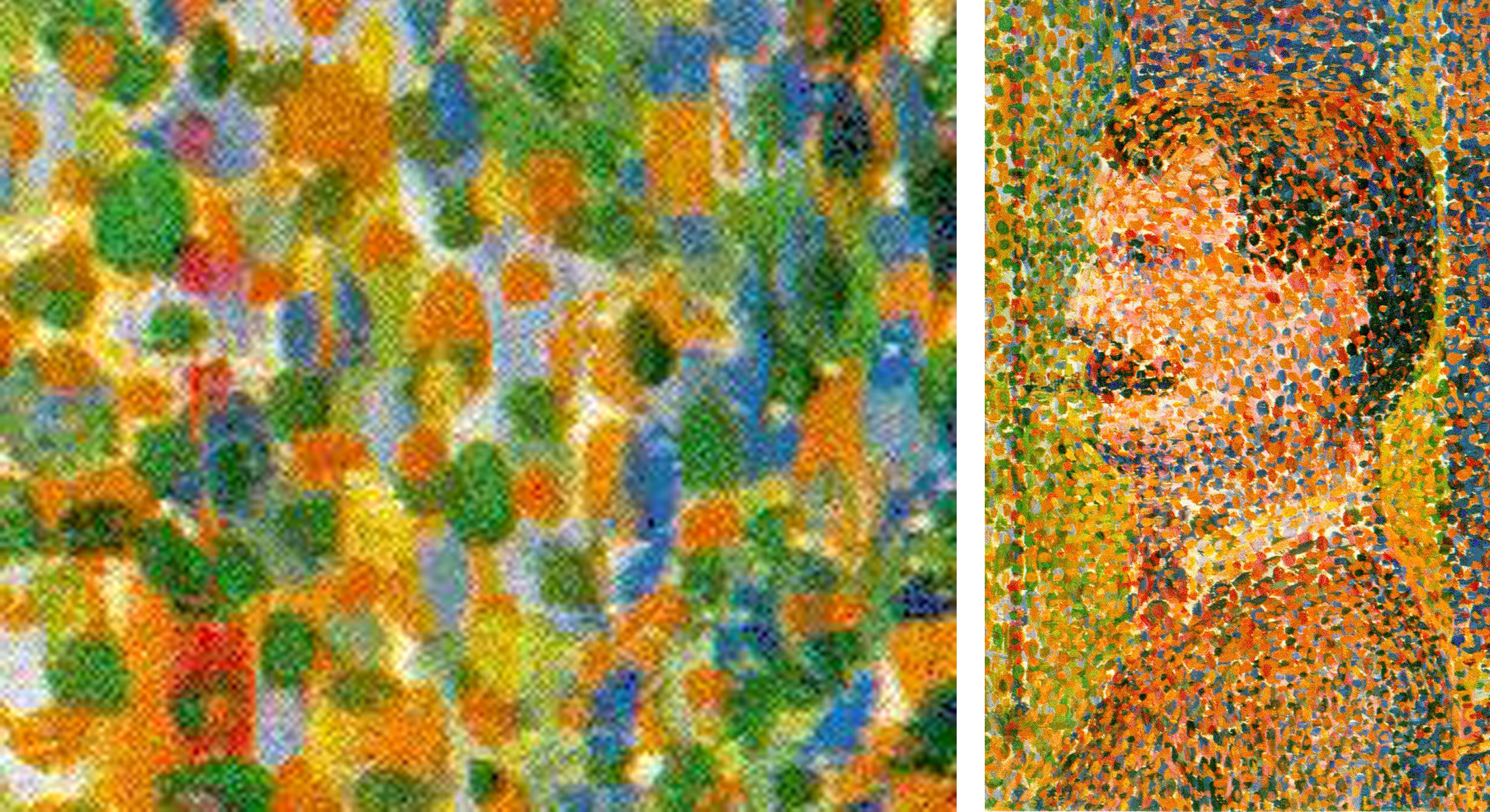
For instance: I cannot possibly reverse the effects of climate change, but I certainly can try to minimize the negative impact of how I live my life. That much I can do. I can’t bring peace to Gaza, but I can choose not to turn the next School Board meeting into some kind of warzone. And while I certainly can’t refill the Great Salt Lake or restore the Central Valley aquifer, as a homeowner I can at least stop watering the sidewalk (my sprinklers are blasting at full-spray even as I write this). And maybe—someday when I am ready—I might consider replacing my beautiful green lawn with something less thirsty. Every little bit helps, and lots of little bits help a lot. By small and simple things are great things brought to pass, as the saying goes. And even if my small and simple contributions are little more than a single violet dot within a massive pointillist landscape, in the big picture I will have made my contribution.
What about you? Perhaps you can do much more than I—perhaps much less—but everyone according to their several ability, as Jesus said. What do you touch? What can you say or do to lift others and make an impact for good? What can you influence to improve our community, to counteract the negative with something wonderful? I might ask the same thing of any student, mother, farmer, or legislator who is part of that community: Think about how you use land and resources, how you interact with those you disagree with. Think about what you prioritize, about how you cast your votes. Ask yourself if there isn’t something small that you could do to make your own small difference. Or something truly grand and consequential, for that matter. Regardless of your circumstances and your sphere of influence, doing the same old thing—whatever that might be—is probably not the best choice available.
Like you, I yearn for a better tomorrow. In the face of the many challenges before us, by all means we should continue to hope and pray for some divine intervention; but after all the hoping and praying, we have to get up and do something. That is the Jesus Way. None of us should be asked to run faster than we have strength, but at the same time it’s not too much to ask each of us to pick up the pace a little, to find ways each day to make our own corner of the world just a bit better—that is, before Jesus comes back to ask us what we did with what we have been given.
PW
Image: Detail from Georges Seurat’s La Parade de Cirque courtesy of Principle Gallery
 Letters to Will