
The End of Life as We Know It

Dear Will:

Life as we know it is about to come to an end. By which I mean that our daughter is about to leave home. Which doesn’t begin to tell the full story.

I’ll try to make it brief: As I think you know, Bryn is a ballerina—a pretty good one if you believe the pundits who know about these things. She has danced many leading roles for her local ballet company. Last year she was a finalist in the annual Spotlight competition at the Music Center in downtown LA, and in January of this year she won gold at the YoungArts competition sponsored by the National Foundation for Advancement in the Arts. Pretty cool.

But things have gotten complicated as Bryn approaches graduation from high school in June. First she was offered a position in the second company of the Houston Ballet (a typical entry-level gig for an aspiring dancer). It was exactly what she was hoping for. But something didn’t feel right, so she turned them down.

A couple of weeks later, Bryn was admitted to Juilliard as one of only 12 female dancers who get admitted each year. After she declined that invitation due to financial concerns (it costs over $50,000 per year), they sweetened the deal and offered her almost a full tuition scholarship. Such an honor! And so enticing! But she turned down Juilliard too.

Then about a week later the unimaginable happened. Bryn was offered an apprenticeship with American Ballet Theatre in New York. Now if you don’t follow the ballet world that won’t mean a lot to you, but it’s bigger than a big deal. To put it into terms that I can understand, it’s sort of like being invited to join the New York Yankees without having to play in the minor leagues first. It’s more than she could possibly hope for coming straight out of high school, the early fulfillment of a lifelong dream.

What this means is that Bryn will have to put her hopes of going to college on hold. And it means that in less than a month, my 17-year-old only-daughter will be moving to New York to start her career. The good news is that Bryn is an exceptional young woman, with her feet firmly planted on the ground (for now, anyway) and with an abiding faith in God. I worry, of course, as any father would, about her safety and happiness. But I do not worry about her priorities. What’s that old proverb? “Train up a child in the way he should go: and when he is old, he will not depart from it” (Proverbs 22:6). Assuming that’s true, Bryn will be fine.

That’s not the only change we’re going to see around here. A couple of months ago I mentioned that my son Luke—the recent college graduate—was discouraged in his efforts to find his first real job. Well to his great relief, he has been offered a position with a small advertising agency in Costa Mesa. He starts next week. He’ll be moving into his own apartment at the end of this month. Thanks to a temp job he landed around the time that I wrote to you, the full extent of Luke’s “unemployment” was about a week. Not bad.

Meanwhile, the nervous dad is about to have a coronary. As I get ready to send two of my three children off into the world to find their way without me, I keep coming back to another passage in Proverbs that provides wise counsel to all of us—the departing children and the worried father alike: “Trust in the Lord with all thine heart; and lean not unto thine own understanding. In all thy ways acknowledge him, and he shall direct thy paths” (Proverbs 3:5 – 6).

PW
That’s It?

Dear Will:

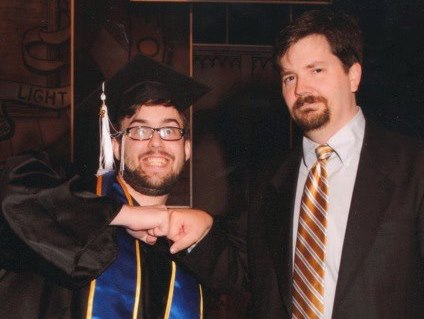
A little over a week ago my firstborn, Luke, graduated cum laude from UCLA with a degree in Communications (Mass Communications, to be precise, with a specialization in Computing and a minor in Human Complex Systems—whatever that is). He had originally planned to go to law school after graduating, but in December it occurred to him that he was much more interested in studying law than in practicing it. So in January he began to look for his first real job.

So far, he has had a few nibbles but no job offers. Because he is bright and inquisitive, well-read and articulate (and highly motivated), I’m confident that he will find work in due course. But now that he has moved back home, he and I are both feeling anxious for him to find work, settle into a place of his own, and get on with life.

When I picked him up from Westwood last week, he told me that he was feeling more than a bit disappointed with the experience of graduating from college—like the whole thing was a bit anti-climactic. “I’ve been pointing to this moment my entire life,” he told me. “Before UCLA, it was all about taking the right classes and getting the grades necessary to get into a good school so that I could get a degree from a respected university. Now that that has happened, I find myself thinking: ‘That’s it? I went through all of that trouble just so that I could move back home and be unemployed?’”

In his current state of mind, Luke is having trouble seeing the bigger picture. He can’t see far enough down the road to appreciate what he has learned or what he has become as a consequence of his 16 years of education. He is not yet old enough or wise enough to recognize his good fortune or his exceptional preparation, to see how the last four years have helped position him to become a meaningful contributor to society. Having traveled that road before him, and knowing as I do many who have been neither so fortunate nor so bright, I know much better than he could that the road ahead for him will be brightly lit and lined with promising opportunities. Luke is disappointed primarily because he still has no real sense of what happens next.

Do you ever wonder if, when you reach the end of your life on earth, you’ll find yourself thinking: “That’s it?” Do you imagine that all of the hard work and trial you may pass through between birth and death will prove to be little more than that—a long slog culminating in a huge disappointment? Do you wonder if the difficulties of mortality will prove to be worth it?

It’s easy to get so caught up in what makes life hard that we don’t fully appreciate the ways in which our mortal existence prepares us for something much greater. Like Luke, we have trouble seeing far enough down the road that we can put this life into its proper eternal perspective. But as Thoreau said: “There is more day to dawn. The sun is but a Morningstar.” It was Isaiah who first penned these words made more familiar by the apostle Paul: “Eye hath not seen, nor ear heard, neither have entered into the heart of man, the things which God hath prepared for them that love him” (1 Corinthians 2:9). The trick, of course, is to move forward with faith, knowing that God’s promises are always—always—sure.

In the short term, my task is to keep Luke believing in the near future, to help him believe in himself and in his preparation sufficiently to convince an employer to believe in him as well. In a few short months, I’m sure his outlook will be brighter. But until then, he still needs a job. Which reminds me: You don’t happen to know anyone who would like to hire a recent college grad who is bright and inquisitive, well-read and articulate, do you?

PW

It’s Time to Start Something

Dear Will:

Well, we’ve done it. Or should I say, we haven’t.

For the last 20 years or so, we have sent out Christmas cards to friends and relations around the globe. In most years, that card has included a letter of sorts, one into which we have invested a considerable amount of time and effort in order to make it witty and worth reading—even if you don’t find our children as interesting as we do. In some years, I have had to submit multiple drafts to get it past my wife (Editor in Chief) because the initial versions were either too boring or too inane or too vacuous or maybe all three. It was sometimes arduous, but we did succeed to some extent in making our letters entertaining enough that some friends encouraged us to keep ‘em coming.

It was a lot easier in the early years, when our children were cute and spontaneously funny in the way that innocents tend to be. But as they have gotten older and we have used up a variety of editorial tricks and angles, making our annual letter even somewhat engaging has become a difficult chore. You yourself may recall a time or two when our effort has fallen well short of the mark. For these and a variety of other reasons we decided that enough has finally become enough. Thus this year there was no card and no annual letter from the Watkins.

When Dana and I finally gave ourselves permission not to send out Christmas wishes, it should have produced in me a great sense of relief. (Confession: My first and only draft of Christmas Letter 2011 was rejected out of hand by the Editor in Chief.) But rather than feeling like I had been let off the hook, instead I have felt great pangs of regret and even guilt for breaking the streak.

The truth is, it’s hard to start something worthwhile, harder still to keep it up over a prolonged period of time. We’ve all embarked on one-day diets or thrown ourselves full force into what proved to be a two-week workout regimen. My wife is one who works out six days a week (every day but Sunday), even when—or I should say, especially when—she doesn’t feel like it. If she’s sick or sore or injured, she refuses to give into the discomfort. “I’m afraid that once I let myself off the hook it will be too easy to stop altogether,” she explains. “And I can’t afford that.”

Several years ago, my son Luke went his entire freshman and sophomore years without missing a day of Early Morning Seminary. He hadn’t set out to have a perfect record, but once he was two years in it became a matter of pride to him. No matter how tired he was or how good an excuse he might have had, by his junior year he refused to miss. Every day, no matter what, he arose before 6 a.m. and made his way down to the church. It was impressive.

Then one day in his junior year it happened: He somehow slept through his alarm and accidentally missed Seminary. He was very upset that his perfect string had been broken. But once it had been broken it became very easy for him to miss again. He still attended, but once he got out of the pattern it didn’t matter as much to him to keep up the consistency.

So it is with many worthwhile endeavors: eating right, visiting the elderly, attending Sunday services, working out. Starting is easy. Stopping is easier. It’s only through consistent follow-through that we can turn good intentions into quantifiable results.

You know why I bring all of this up, don’t you? As we embark on a new year, we’re pondering resolutions and commitments and (if you’re like me) contemplating what we can do to make this year better than last year. The next few days will be filled with good intentions. The question is this: A year from now, which of those good intentions will have transformed us and which will be mere memories? It’s time to start something. And when you do, don’t stop.

PW