Yet Another Handful of Grain

Dear Will:

I’m prepping for another backpacking trip with my daughter, and as I always do I have pulled out a shake-down list I solicited years ago from my friend Warren, who is singularly responsible for my willingness to attempt these crazy adventures in the first place. The checklist is full of the obvious and not-so-obvious (which is why I mooched it to begin with). But there at the top—before he gets to mole skin and duct tape and paracord—Warren includes the following note: “Just remember the lesson we learned: No more than one pass a day!”

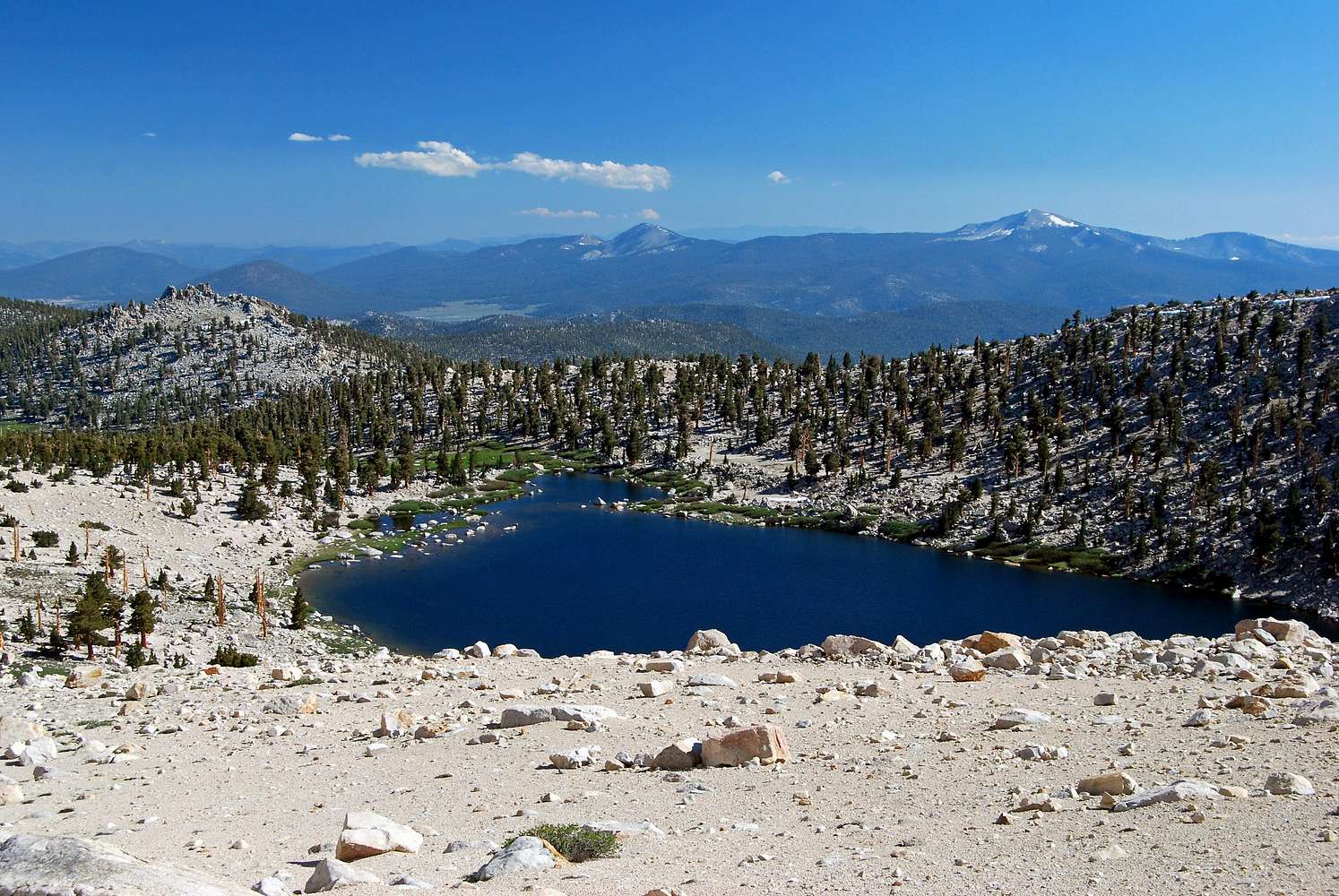
Ah yes, that fateful day coming back from Mt. Whitney when we decided to go over Guyot Pass (10,900 feet), down to Rock Creek (9,820), and then to the meadow (11,060) midway to Cottonwood Pass where we expected to set up our tents for the night. As we approached the meadow, everyone in our group agreed that we could go no further. We counted our steps, wondering how much trail remained. Time dragged. So did our feet. At last we reached the open pasture, gassed and parched and ready to flop down in exhaustion. That is, until we were informed that the springs at the meadow had all run dry. The nearest water, in fact, was another four miles up the trail at Chicken Spring Lake.

What a punch in the empty gut. Yet there was nothing to be done but moan, hoist our packs, and begin again. We had already determined that we could go no further . . . until we had to. Dehydrated and calorie-starved, we somehow made our way to Chicken Spring Lake after dark, and by the light of our headlamps we filtered our water, cooked our food, set up our tents, and collapsed into our sleeping bags, swearing (as previously noted) to never do that again. 

Perhaps you’ve been there yourself. Not at Chicken Spring Lake, per se, but metaphorically for sure—someplace near the point where you are certain you can do no more. Maybe in the midst of an overbooked, hyper-stressful schedule one of your children lets you know that her marriage is starting to fray. Or you have one of those phone calls with an aging parent that makes it clear that he is really starting to slip. Maybe you get hit with one of those unexpected expenses that you have no way of paying. Meanwhile, you still have to do the everydays: make the meals, help with the homework, fix the broken sprinkler, prepare to teach your Sunday School class. Everywhere you turn you are expected to do more, give more, be more, and at some point you feel that you no longer have it in you.

And right about then, when you feel you have given all you have and even a bit more, at church they ask you to take on a new assignment, or you get laid off at work, or your closest friend comes to you in tears asking you to lift her burden. And it’s all so overwhelming that just about all you can manage is that popular, one-word prayer: “HELP!”

And yet somehow, in that moment, you find a way. You know just what to say to your troubled friend. Perhaps you remember a verse of scripture, and although you don’t know where it is or exactly how it goes it is nonetheless just the right thing for her at just the right time. In that instant you find “strength beyond your own” to enable you to go one more day, or one more hour, or one more step, and maybe carry someone else with you as you go.

At times like this, I often think of the poor widow who lived with her son in the town of Zarapheth. She faced poverty made worse by drought which led to famine. She had done all she could to care for her son, but when the food finally ran out, so did her hope. Knowing she had just enough meal in the barrel and oil in the cruse to make one last cake for her and her son, she headed out one sad morning to gather sticks to build a fire to cook what she believed would be their last supper. She had done all she could and had nothing left to give.

But then—of course—she was asked to do one thing more. A stranger stopped and asked her to fetch him some water and bread. When she explained her tragic circumstances, he gave a stupefying response. “Make me first a cake,” he said, “and then make a cake for you and your son. Do this and the meal in your barrel and oil in your cruse will never run out.” Which she did. And the stranger, Elijah the prophet, made good on the miraculous promise.

When asked to do something especially hard, this widow did so in faith, and God blessed her for it. I love this story because I see in it a promise to us as well: That if we can hold onto our faith in the midst of difficult times—rather than curse God for our misfortune—perhaps we may lay up in store for a future moment in which all we have to give is still not enough. My faith and personal experience tell me that such efforts invite compensatory blessings that will be made available when we need them most.

It won’t be because we have lived such good lives that somehow we have earned it—not strictly anyway. But it may be a merciful nod toward our faithful efforts to give “such as we had” at some point in the past. And because of our faith and our willingness to do hard things when things got hard, it will be as if we reached into our empty barrel and found yet another handful of grain. We will tip our empty cruse and somehow oil will once again come trickling out. And when that miracle happens—and it will—we will feel the love of God, perhaps like we never have before. We will know that He sees us, He knows us, He loves us, and He has once again fulfilled His promise that we will never walk alone.

I don’t know exactly how this works. But it does. And it always will. 

PW

P.S. Bryn and I will be hiking past Chicken Spring Lake on Tuesday. I’m thinking perhaps we should stop for water.

Photo by Pilz8 on SummitPost.org

A Little Perspective on Life

Dear Will:

For Christmas, my son Luke bought me a one-year “subscription” to StoryWorth. Every Monday, I get an email, prompting me to respond to a question about myself as a keepsake for my children and granddaughter. This week’s question: How has your faith influenced your perspective on life? Since you and I have become close over the years, I thought I would share my answer with you as well.

First, some context: Through my mother, I am a sixth- or seventh-generation Mormon (depending on which genealogical line you trace), a member of the Church of Jesus Christ of Latter-day Saints. For his part, my father claimed to be a member of the Church of England, which, he said, explained why he didn’t attend services (too far away). So as I was growing up, my mother would schlep me and my six siblings off to church services each Sunday while my dad stayed home tending the pot roast. Throughout my formative years, I remained an obedient but indifferent member of the Church, not thinking much about it or its teachings one way or the other. While other kids my age dutifully played along and parroted the standard professions of faith and belief that they were taught, I remained a detached observer—in the Church but never really of the Church, if you catch my meaning. As I observed my older siblings testing various types of rebellion and defiance, I assumed that one day that would also be me.

When I was 14 years old, my family moved from Redlands to Glendora, California—just as I was entering the ninth grade—and things changed for me dramatically. At a junior high school, the ninth-graders were the old kids, the cool kids, and without upperclassmen to put us in our places we worked hard to act more grown up than we really were. Because I was the new kid in town, I got invited to parties, offered weed, pulled this way and that by different social groups who were trying to figure out if I was one of them. I wondered if I might be as well. I recall being asked about my beliefs and personal practices (“So, do you drink?”) and always answering awkwardly, usually making up some excuse for being a straight arrow because I had not taken the time to decide for myself.

Meanwhile the kids in my church social group were tugging me in another direction altogether, and in time, without really making a conscious choice, I found myself pulled into their orbit. At some point, I couldn’t really tell you when exactly, I made the choice to lean in and truly become the thing I had spent 15 or 16 years merely observing. While I don’t recall the particulars, this much I remember distinctly: at 15 I didn’t really know what I believed; but by 18 I had decided to become a missionary. Those two years in Uruguay were life-altering, and I have remained actively involved in my church ever since.

But all of that is merely preamble—necessary backstory, I think, since so much of what I believe and how I live has been influenced by my association with the Church. But what of the question regarding my faith? Rather than delve into lots of religious doctrine, let’s just focus on those of my core beliefs that really get to the heart of the question:

All my life I have believed in God—that part has been easy for me. I tend to agree with the Book of Mormon prophet Alma who said that “all things denote there is a God.” As I observe the wonders of the world around me, it just seems obvious (concurrent evil and destruction notwithstanding). Beyond those observations, I have had moments of clarity when I have felt God’s presence and an assurance that He has touched my life in a number of significant ways. Along with that baseline belief, I have faith that there is more to life than what we can extract from our 90-or-so years of mortality—that I pre-existed and that I will continue living beyond the grave. I could say more on this—much more in fact—but rather than turn this into a sermon, let’s get to the point about how all of this has influenced my perspective on life.

Because of my faith, I believe that what I do in this life—or more to the point, what I become—really matters. I have spent most of my life striving to become a better version of myself—kinder, less selfish, more patient, more virtuous, more loving. The idea that we should love one another and treat one another as we wish to be treated is not unique to my Christian faith, but it certainly informs how I choose to live. It’s easy to imagine that I would be a very different sort of person if I thought that ultimately how I interact with others is just a choice that really doesn’t matter. You don’t have to be a person of faith to believe and to try to live by the Golden Rule, of course. But for me, it has helped me tremendously to be preached at regularly and to be surrounded by others who are striving imperfectly, just like me, to be better tomorrow than we are today. Not that I’m doing it for show, but I would hope that others could observe my life and see evidence of my faith in the choices that I have made. They will also see plenty of evidence of times and circumstances when I have fallen far short of my own aspirations (sorry), but in its totality, I hope the trend of my life is in the right direction—that I have made at least some progress since my days at Goddard Junior High.

Because of my faith, I tend to be more optimistic than pessimistic, a man more prone to hope than to despair. That hopeful perspective has been tested in recent years—by political and environmental issues, in particular—but I try to maintain an “eternal perspective” when I start to feel the negativity drag me down. Over the last few years, I find myself returning again and again to something the Apostle Paul said in his letter to the Romans: that “all things work together for good to them that love God.” That isn’t to say that it will be easy or even just easier for me because of my faith, but I do think my faith helps to carry me through the rough times. In 1999, Elder Jeffrey R. Holland gave a discourse that I love, a sermon that captures in better words than I could hope to compose the nature of my hopeful perspective in the face of adversity. I wholeheartedly recommend that address to anyone and everyone.

And finally, because of my faith, I have no fear of death. Rather I anticipate it with curiosity and wonder. It has been painful for me to lose loved ones—to be sure—but I have taken comfort in the surety that we may be reunited one day. I remember sitting with my mother during her final months on earth when her body was breaking down and she was ready to move on. She said: “I want to see what it’s like.” I have a few more years left in me (I hope), but I agree with her on the essential point: this life is great, but there are even better things to come.

Thanks for asking.

PW

Photo by Benjamin Davies on Unsplash

It Takes a Whole Lot of Faith to Be an Atheist

hacat-culture-cells-light-micrograph-dr-torsten-wittmann

Dear Will:

Apparently, however-many billions of years ago, some sort of singular event, currently unexplained by our understanding of astrophysics, caused the universe to begin expanding rapidly. The exact cause no one really knows. But that this Big Bang happened is not really in dispute. Emanating from this “singularity,” eventually clumps of matter took their places in the cosmos, including one orb that settled, fortuitously, in rotation around our sun, close enough to keep us warm but not so close (or so far away) to make the place uninhabitable. Not that there was anything there to inhabit it, mind you, but it was a start.

From there the random good fortune continued. Atoms became molecules, hydrogen and oxygen somehow began combining to form H2O, essential for the formation of life. How did it happen? Natural forces combined with a whole lot of luck, apparently.

By chance (millions and millions of years later, perhaps) single-cell organisms appeared(!), and completely on their own, they began combining or splitting, or splitting and combining—in any case, they began spontaneously forming more complex organisms. I’ll skip over the boring parts here, but through more natural forces and random bits of randomness eventually we went from protozoa to pollywogs to people, with millions of variations of plants and creatures also forming, cell by cell, along the way. Each iteration and permutation came about by accident, it seems, with the best mutations sticking around and the not-so-great ones never really getting a foothold. And now, billions of years later, you have, by pure chance really, the redwoods and the bougainvillea, the guppy and the humpback whale, cheetahs and gazelles and the blue-footed booby, not to mention the dodo and the diplodocus, the earthworm and the bark beetle, and whatever is the latest craziness they have going on over there on Galapagos Island. Oh, and the duckbilled platypus. Can’t forget the platypus.

That detour from pollywog to person could not have been very straightforward. Think of all of the random wrong turns and dead-ends we must have headed down before we could ever arrive at, say, Mike Trout or Misty Copeland. For instance, it would have been theoretically possible—perhaps even easier from a purely developmental standpoint—to randomly generate one eye rather than two. No question. But two is better, so fortunately for us it all worked out. Solely dependent on natural forces and infinite randomness, we also ended up with two feet loaded with all kinds of handy metatarsals. We’ve got eight yards of intestines (two kinds!), a pancreas and a spleen, and only one fairly useless gall bladder. And hemoglobin! Somehow the randomizer even came up with hemoglobin, usually in just the right proportion to everything else. Not bad considering that it all had to happen more or less by chance.

But that’s really only half the story. In order for all of that serendipity to work out for you (including the hemoglobin), you’re going to need to end up eventually with two versions of homo sapiens, with mostly the same parts but several totally different ones, also developed by random chance, but also with such marvelous complementarity that combined in just the right way you can churn out others just like them on an almost annual basis. That’s two different but complementary models, simultaneously produced following synchronized, billion-year development. Preposterous? Perhaps. But given enough time and random good fortune it could happen. Because apparently it did.

I must emphasize here that I’m no astrophysicist, geneticist or nuclear biologist, so some might (rightly) quibble with how I laid things out here. I’m quick to admit that I may have been overly reductive, perhaps misrepresenting or oversimplifying the basic theory in some of the particulars. But I believe this is the gist of what we are supposed to believe about how we got here today: Start with an untriggered event in the cosmos, wait around through billions of years and quadrillions of random microbiological mutations and eventually you’ll find yourself reading this letter from me.

Or you can believe in God.

Or, to be more precise, you can believe in God and just about all of that other stuff as well. In the singularity. In the combining of molecules and the natural selection of species. In the self-evident reality of evolutionary principles and the age of the ever-expanding universe. The choice is not between science or God, it’s between a belief in the power and inevitability of chaotic happenstance, on the one hand, or a belief in a Creator helping to steer toward a desired outcome, on the other. You may believe that everything you see (and your ability to see it) is the result of billions and billions of unplanned, spontaneous deviations, or you can believe that God had a hand in it. But be honest: Which of those requires a greater leap of faith?

To see what I mean, you may wish to try this simple experiment. Go down to your nearest maternity ward and find your way to the side of a mother with her newborn. Look at that exhausted, joyful woman, more beautiful in that moment than perhaps she has ever been in her life. Look at how she stares at her little one. Now look at the babe—its tiny knuckled fingers, the fleshy excess on the palm that gives the thumb its perfect movement, the wrinkled ears, the nib of a nose, the round, wondering, miraculous eyes. Look how it suckles, still nurtured and sustained by its life-giving mother. Now listen to the voice inside your own head.

Which phrase comes most readily to mind: “Wow, that was lucky,” or “Oh, my God”?

PW

[NOTE: Several people have objected to my original characterization of the evolution of genders, which, given my lack of credentials, should surprise no one. Subsequently, I have updated this post in an effort to reduce that apparent misrepresentation. To truly understand prevailing evolutionary theory, however, I urge you to turn to a more reputable and better informed source than I.]


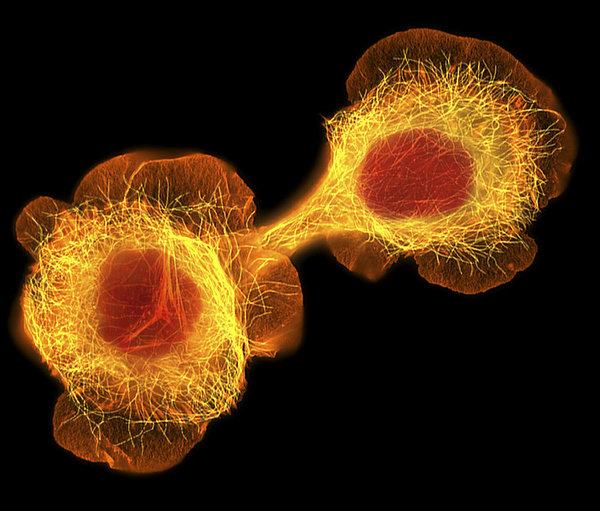
Photo: Hacat Culture Cells, Light Micrograph by Dr Torsten Wittmann