Everyone Singing from the Same Song Sheet

Dear Will:

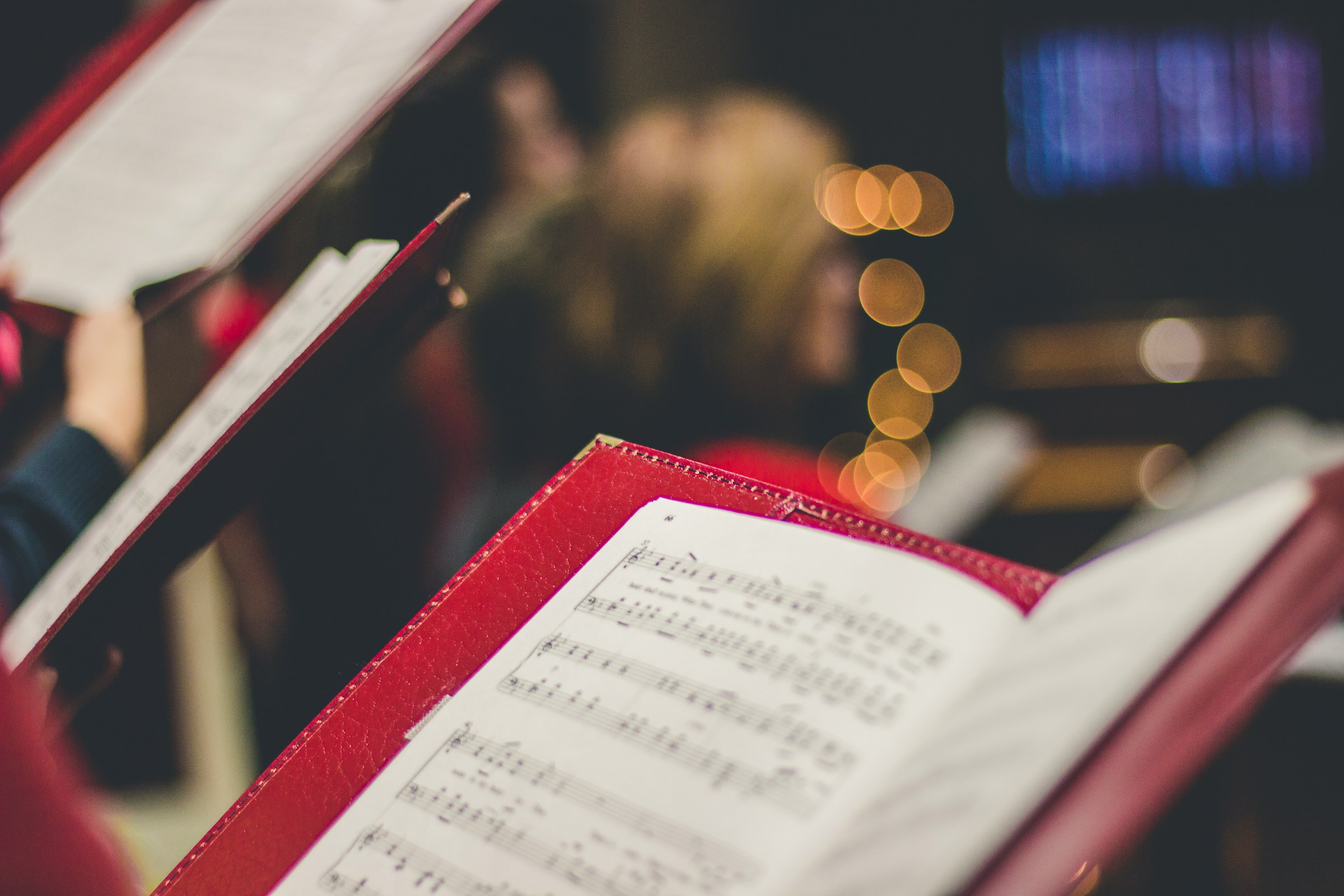
A couple of weeks ago we attended the annual Holiday Wassail Concert at Chapman University. The event, showcasing the Chapman University Orchestra and various choral groups from around campus, featured an array of songs from across the spectrum: from popular, just-for-fun secular numbers like “Sleigh Ride” to sacred and sublime traditional favorites like the Hallelujah Chorus from Handel’s “Messiah.”

It’s hard to say exactly why, but the night kind of snuck up on us. Something about the spirit of the season, perhaps, made us vulnerable, and Dana and I found ourselves feeling emotional from the very first note. The choir and orchestra opened the evening with “O, Come All Ye Faithful,” the much-loved Christmas hymn. All at once the house lights came on and the conductor turned toward the audience, inviting us to sing along.

We tried. We really did. But soon we were fighting tears and choking out, “Sing, choirs of angels; sing in exaltation!” And so they sang . . . but we could not.

Perhaps our favorite song of the night was a magnificent Jewish hymn with which we were unfamiliar: “Hine Ma Tov,” with Hebrew lyrics taken from Psalm 133. The King James translation renders its message like this: “Behold, how good and how pleasant it is for brethren to dwell together in unity!”

Indeed, that is the message of the season, and we were feeling it to our very core. Those choirs of angels had sung something similar on that first Christmas night: “Peace on earth, good will toward men and women everywhere!” That invitation to love and unite transcends both time and religion. It beckons each of us to stop fighting with one another, to break down barriers, to come together as brothers and sisters, fellowcitizens, children of God.

Jesus himself was a Jew, one well familiar with scripture—including, no doubt, Psalm 133. He might very well have preached that same message of unity while sitting on a hillside or standing in the synagogue. His most famous sermon, given on a mount in Galilee, included these words of counsel that still echo across the generations: “Blessed are the peacemakers. . . . Be reconciled to thy brother. . . . Love your enemies, bless them that curse you, do good to them that hate you, and pray for them which despitefully use you, and persecute you.” He called on us to judge reluctantly and generously, to treat others as we would wish to be treated. He taught that love is the ultimate mark of discipleship. He commended those who fed the hungry, welcomed the stranger, visited the sick and the imprisoned.

His empathy knew no bounds.

To some he was a great philosopher, to others a prophet among many, and to others, like us, the very Messiah himself. At this time of year especially, Dana and I celebrate his life and teachings full-throatedly (if we can choke out the words). And to his teachings, we add this prayer of our own: May the feelings we share in December pool within each of us, providing a well of living water from which we can draw throughout the year ahead.

Hine ma tov.

PW

Photo by David Beale on Unsplash

Presents of Mind

Dear Will:

Just by hanging around we have managed to live through over five dozen Christmases. For just a couple of humble heads, that’s a lot of dancing sugar plums. We figure that over the course of two lifetimes we have received hundreds of gifts around the holidays, some magical, some practical, most all of which, we hesitate to admit, we have already forgotten. (Except that thing you gave us that one time. We still have it and cherish it. Use it all the time. To this day we just love it. It’s our favorite.)

OK, in fairness, we’re not as sharp as once we were and our synapses fire only inconsistently at best. So maybe some really great stuff just sort of slipped out of our brains while we were trying to find our reading glasses. But try this experiment and see if you can do any better: Look around your home and see if you can identify more than, say, three or four things that you can associate with a specific Christmas giver. You don’t even have to limit it to what’s currently in your home. Open up whatever is left of your memory and scan all of the Christmases come and gone. How many of the dozens of presents you’ve received do you still recall to this day? Not that many, we’re betting.

Or if you think you can take it, here’s an experiment we do not actually recommend: Ask your spouse or kids or significant someone which gifts they remember getting from you over the years. When you do that, you’ll probably be thinking of a couple that you were certain you got just right. Look into their eyes anticipating the sparkle that will settle upon them as they recall the tenderness of the moment and the thrill of the receiving. Just don’t be surprised if instead they furrow their brows and admit that nothing immediately comes to mind. 

What you and your loved ones are more likely to remember are favorite holiday traditions, most of which have nothing to do with the stuff under the tree. Unsurprisingly, those are memories rooted in doing and feeling rather than getting. And before you know it, those memories may start to give way to the sounds of Whos down in Who-ville, singing their Christmas morning song. And perhaps you’ll think: Well, of course! It’s not about ribbons. It’s not about tags. It’s not about packages, boxes, or bags. Boris Karloff says as much every year about this time. And perhaps then your mind will drift to a dimly-lit stage where Linus is reciting from the book of Luke. And you’ll think: He’s been preaching that same sermon since the sixties, but somehow it never seems to fully land.

Which is why, when you finish reading these last few lines, you’ll still be tempted to put down this letter, open up your browser, and click on Gifts for Her—because you can never figure out what to give your mother who always says, with unquestionable sincerity, that she doesn’t really want anything but love and peace and common courtesy. (At this very moment, we are likely in the midst of doing something similar ourselves.) After all, the wrapping and the giving is a way of saying (poorly) a thing that words don’t properly convey. 

Those kinds of urges—to do something nice for those we love—we should always give in to, even when they lead us inexorably to Amazon. But after you BUY NOW, it will be even more worthwhile to ponder if there might be a better way. Because deep down you know there is. You just have to figure out what to do about it.

When you do, please let us know. Because we have this one friend who is impossible to shop for.

This letter is an imperfect way of expressing our love and wishing you holidays filled with the very best gifts of all. 

PW

Photo by Kira auf der Heide on Unsplash

“Santa Came! Santa Came!”

Dear Will:

I grew up in a loud, frenetic home. In addition to my parents, there were seven of us kids, born oldest-to-youngest in just a 10-year span. (I’ll pause to let that sink in.)

Imagine Christmas in that house. When we were little, the place pulsed with nervous energy. I can remember scrambling around the tree together, counting and sorting and speculating over what made one gift rattle or gave another its unique shape. Who knows what kinds of calculations took place in my parents’ quiet hours together (did they even have quiet hours together?) as they tried to ensure that no child felt overlooked or under-loved.

By Christmas Eve, the wave of excitement crashed upon the family shore, sending its exuberant spray in all directions. As I recall, the yule feast was typically a rib roast with Yorkshire pudding and . . . I have no idea what else. Afterward, we would gather for an abbreviated Christmas program of some kind. There again memory fails, but for sure we sang some, with Santa songs woven indiscriminately among the sacred hymns and carols of Jesus—it was all Christmas to us kids.

Eventually we hung our matching stockings and scurried off to bed. From that point, the living room was technically off limits, but you can bet that by 4 a.m. anticipation would overwhelm sleep, and one or more of us would begin slinking up and down the hallway, flashlighting our way through the fresh booty that had appeared while we were “asleep.” (One year my younger brother Michael woke me with a beam of light to the face. “You got a bike!” he announced. My corneas have not recovered.) Once we had assembled a critical mass, our clumsy eagerness would betray us and we would be shooed back to bed by a disheveled parent. But rather than return to bed, we would huddle in one of the bedrooms, chatting anxiously while we awaited the celebratory signal: my father shaking a string of bells and exclaiming, “Santa came! Santa came!”

All these years later, my memory clings to a smattering of snapshots from specific Christmases, but the details of those gleeful hours have mostly faded. Faded, that is, with one prominent exception: Every Christmas Eve, as the after-dinner festivities drew to a close, we would gather for a reading of the familiar King James account of the First Christmas Ever. My father would drag out the family Bible—one of those gigantic tomes meant mostly for display—and share with us the account of the birth of Jesus as recorded by Matthew and Luke. My siblings and I were never what one would consider especially (or even somewhat) reverent, but in my memory we sat quietly for this. He was not an especially religious man, my dad, so when he read scripture, it was a very special thing.

Hearing my father recite that familiar account remains for me the most sacred thing imaginable. It had a greater effect on me than any of the baubles stuffed into stockings or concealed beneath the tree. Among my sundry childhood memories, it remains among the most precious, perhaps because of how it made me feel. Memories of the Spirit are that much harder to forget.

Oh, but how time passes relentlessly on. As we grew, whichever of the brood was near enough at hand would reunite each year in my parents’ home, now with our own children creating the energy of anticipation and wonder. As marriages added in-laws to the mix, new traditions mingled with the old; but the most treasured tradition remained inviolable: We would sit, and my father would recount the tale of angels and shepherds and a miraculous, life-changing, world-saving baby boy. Until he no longer could. The year his eyes failed and my dad asked me to take his place with the family Bible, I felt both disappointed and unworthy. I did the best I could, but clearly it wasn’t the same. Nor is it. My dad has been dead now for over ten years, and still I miss him all the time—never more than on Christmas Eve.

In a couple of weeks, a smaller group will gather in my own home. It will be just Dana and I, Seth and (maybe) Bryn, plus a couple of dear friends. There will be no Yorkshire pudding (who knows how to make Yorkshire pudding?), but it will be lovely nonetheless. We’ll be missing the magic that small children lend to such an event, but when we read of the Nativity, we will still feel the spiritual warmth that story always brings. Come morning, my grown children will sleep until I can stand it no longer. Eventually, I’ll reach for a string of bells and make the big announcement: “Santa came! Santa came!”

PW