
A Little Perspective on Life

Dear Will:

For Christmas, my son Luke bought me a one-year “subscription” to StoryWorth. Every Monday, I get an email, prompting me to respond to a question about myself as a keepsake for my children and granddaughter. This week’s question: How has your faith influenced your perspective on life? Since you and I have become close over the years, I thought I would share my answer with you as well.

First, some context: Through my mother, I am a sixth- or seventh-generation Mormon (depending on which genealogical line you trace), a member of the Church of Jesus Christ of Latter-day Saints. For his part, my father claimed to be a member of the Church of England, which, he said, explained why he didn’t attend services (too far away). So as I was growing up, my mother would schlep me and my six siblings off to church services each Sunday while my dad stayed home tending the pot roast. Throughout my formative years, I remained an obedient but indifferent member of the Church, not thinking much about it or its teachings one way or the other. While other kids my age dutifully played along and parroted the standard professions of faith and belief that they were taught, I remained a detached observer—in the Church but never really of the Church, if you catch my meaning. As I observed my older siblings testing various types of rebellion and defiance, I assumed that one day that would also be me.

When I was 14 years old, my family moved from Redlands to Glendora, California—just as I was entering the ninth grade—and things changed for me dramatically. At a junior high school, the ninth-graders were the old kids, the cool kids, and without upperclassmen to put us in our places we worked hard to act more grown up than we really were. Because I was the new kid in town, I got invited to parties, offered weed, pulled this way and that by different social groups who were trying to figure out if I was one of them. I wondered if I might be as well. I recall being asked about my beliefs and personal practices (“So, do you drink?”) and always answering awkwardly, usually making up some excuse for being a straight arrow because I had not taken the time to decide for myself.

Meanwhile the kids in my church social group were tugging me in another direction altogether, and in time, without really making a conscious choice, I found myself pulled into their orbit. At some point, I couldn’t really tell you when exactly, I made the choice to lean in and truly become the thing I had spent 15 or 16 years merely observing. While I don’t recall the particulars, this much I remember distinctly: at 15 I didn’t really know what I believed; but by 18 I had decided to become a missionary. Those two years in Uruguay were life-altering, and I have remained actively involved in my church ever since.

But all of that is merely preamble—necessary backstory, I think, since so much of what I believe and how I live has been influenced by my association with the Church. But what of the question regarding my faith? Rather than delve into lots of religious doctrine, let’s just focus on those of my core beliefs that really get to the heart of the question:

All my life I have believed in God—that part has been easy for me. I tend to agree with the Book of Mormon prophet Alma who said that “all things denote there is a God.” As I observe the wonders of the world around me, it just seems obvious (concurrent evil and destruction notwithstanding). Beyond those observations, I have had moments of clarity when I have felt God’s presence and an assurance that He has touched my life in a number of significant ways. Along with that baseline belief, I have faith that there is more to life than what we can extract from our 90-or-so years of mortality—that I pre-existed and that I will continue living beyond the grave. I could say more on this—much more in fact—but rather than turn this into a sermon, let’s get to the point about how all of this has influenced my perspective on life.

Because of my faith, I believe that what I do in this life—or more to the point, what I become—really matters. I have spent most of my life striving to become a better version of myself—kinder, less selfish, more patient, more virtuous, more loving. The idea that we should love one another and treat one another as we wish to be treated is not unique to my Christian faith, but it certainly informs how I choose to live. It’s easy to imagine that I would be a very different sort of person if I thought that ultimately how I interact with others is just a choice that really doesn’t matter. You don’t have to be a person of faith to believe and to try to live by the Golden Rule, of course. But for me, it has helped me tremendously to be preached at regularly and to be surrounded by others who are striving imperfectly, just like me, to be better tomorrow than we are today. Not that I’m doing it for show, but I would hope that others could observe my life and see evidence of my faith in the choices that I have made. They will also see plenty of evidence of times and circumstances when I have fallen far short of my own aspirations (sorry), but in its totality, I hope the trend of my life is in the right direction—that I have made at least some progress since my days at Goddard Junior High.

Because of my faith, I tend to be more optimistic than pessimistic, a man more prone to hope than to despair. That hopeful perspective has been tested in recent years—by political and environmental issues, in particular—but I try to maintain an “eternal perspective” when I start to feel the negativity drag me down. Over the last few years, I find myself returning again and again to something the Apostle Paul said in his letter to the Romans: that “all things work together for good to them that love God.” That isn’t to say that it will be easy or even just easier for me because of my faith, but I do think my faith helps to carry me through the rough times. In 1999, Elder Jeffrey R. Holland gave a discourse that I love, a sermon that captures in better words than I could hope to compose the nature of my hopeful perspective in the face of adversity. I wholeheartedly recommend that address to anyone and everyone.

And finally, because of my faith, I have no fear of death. Rather I anticipate it with curiosity and wonder. It has been painful for me to lose loved ones—to be sure—but I have taken comfort in the surety that we may be reunited one day. I remember sitting with my mother during her final months on earth when her body was breaking down and she was ready to move on. She said: “I want to see what it’s like.” I have a few more years left in me (I hope), but I agree with her on the essential point: this life is great, but there are even better things to come.

Thanks for asking.

PW

Photo by Benjamin Davies on Unsplash
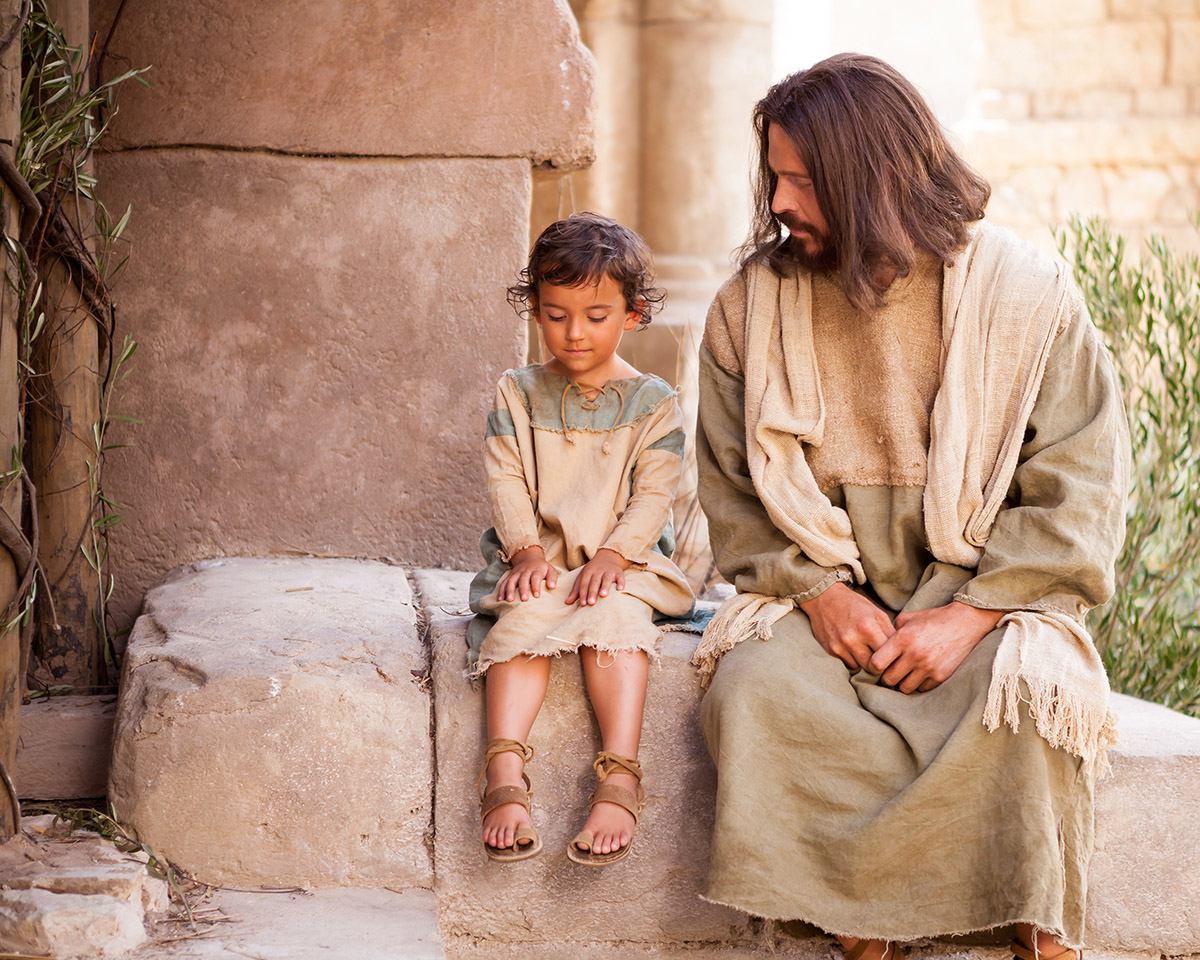
Thanks for Asking

jesus-with-a-child-medium

Dear Will:

It’s true. I’m a Christian. Have been all my life. I think you probably knew that already.

Yeah, but what kind of a Christian are you?

Well, I suppose that by some external measures, someone else might consider me relatively devout. I’m a scripture-reading, services-attending, Sabbath-observing, tithe-paying, prayer-offering Jesus-follower. But we both know that there are plenty of people who do those same sorts of things and yet don’t seem especially Christian, just as there are plenty who do none of those things and seem a lot more Christian than so-called true believers. So I suppose those external measures really don’t tell you much, do they?

Nope. Seriously, what kind of a Christian are you?

Let me try this again. From the time I was a small child, Jesus and His teachings were a central part of my life. Thanks to a devoted mother, I suppose I was swept along by the current of faith that swirled around me. So when I was about eight years old it seemed only natural to own being Christian in some sort of formal way. Although I’m sure I didn’t fully understand it at the time, when I was baptized I was making a public declaration of my Christianity, taking His name upon me in a ceremonial way while committing to follow His teachings and keep Him top-of-mind in everything I do. Inherent in that vow of faith was a pledge to help others, to lift them when they fall, to comfort them when they’re hurting, to mourn with them at times of genuine sorrow. To love others in the fullest sense possible.

More importantly, in choosing that path I accepted a gift that Jesus offers to everyone. In pledging to follow Him, I acknowledged Him as my Savior—one who had willingly taken upon Himself responsibility for my sins and weaknesses. It wasn’t an offloading of my accumulating burden so much as it was a releasing of it, an acquiescence to Him and His desire to take it from me. It wasn’t granted based on personal merit—I  could never earn charity of such magnitude—but rather given freely as an incomprehensible act of love. That free gift—that grace—He offers still, day after day, and as I strive to honor my baptismal promises I accept it from Him again and again and again.

(Sigh.) You’re still not answering the question.

(Sigh.) Do you mean what brand of Christian am I? What denomination do I belong to? Well, for all my life I’ve been a member of the Church of Jesus Christ of Latter-day Saints. In the popular vernacular you’d probably call me a Mormon. Just like the name Christian, Mormon was originally coined as a pejorative, but I don’t really mind it if categorizing me is for some reason helpful to you. Still I fear that in using that label you may mistakenly believe that I worship the prophet Mormon, which would be kind of like accusing a Lutheran of worshiping Martin Luther. If you ask what I prefer, however, I’ll ask you to call me a Christian. As I told you, that’s the name I claimed as my own and have retained since I was a boy.

Fair enough. Now I understand.

Actually, if that’s what you were asking, then I’m afraid that you don’t understand at all. So let me try this one last time: On Sundays, the children sometimes sing a song by Janice Kapp Perry that answers your question better than anything else I can think of. This is the kind of Christian I am:

I’m trying to be like Jesus; I’m following in his ways.
I’m trying to love as he did, in all that I do and say.
At times I am tempted to make a wrong choice,
But I try to listen as the still small voice whispers,
“Love one another as Jesus loves you.
Try to show kindness in all that you do.
Be gentle and loving in deed and in thought,
For these are the things Jesus taught.”

That’s me. Trying, getting it wrong as often as not, and trying again. And trusting in Him that somehow, through His grace, it will all work out. I’m that kind of Christian.

Thanks for asking.

PW

The Great Thing About Brittany

Dear Will:

I have a niece who is stunningly beautiful—double-take gorgeous—the sort of blond-haired, blue-eyed twenty-something girl who gets noticed by simply entering a room. I’ve known her all her life, and even so, when I see her at family gatherings I can’t help remarking on it. I’ll say to her mom (my sister-in-law Kelly): “Brittany is so pretty!”

Invariably, Kelly responds with something like this: “The great thing about Brittany is that she has such a good heart.”

And it’s true. Throughout her teens, Brittany was active in her youth group at church, always striving to do the right thing. She has always been a dedicated Christian and has even expressed some interest in working in a youth ministry for a career. She is consistently kind and thoughtful, quick with a smile and unwaveringly tolerant of her boorish relatives. In short, she has turned out to be the kind of person any parent would wish for at the time of a child’s birth.

What Kelly is trying to teach me, without being even somewhat heavy-handed about it, is that Brittany’s true beauty lies within. What makes her special is not the blue eyes, but rather the kind heart. I was reminded of that principle earlier this week by, of all people, a talk-radio host. He said that in our frenzy to add to our children’s academic credentials and to feed their extracurricular interests, we should also devote a concerted effort to teaching them integrity, honesty, virtue, and kindness. His point was a good one: In the end, it will matter much more to me what kind of people my children become than what their professional credentials or social status might be.

Do you remember the Old Testament story of the anointing of David? It taught the same principle. The Lord sent the prophet Samuel to visit Jesse, with the specific purpose of anointing a new king in Israel. The plan was for Samuel to offer a burnt offering with Jesse and his sons, with the promise being that the new king would be revealed to Samuel while he was there.

When Samuel met the first of Jesse’s sons, however, the Lord gave the prophet this counsel: “Look not on his countenance, or on the height of his stature; . . . for the LORD seeth not as man seeth; for man looketh on the outward appearance, but the LORD looketh on the heart” (1 Samuel 16:7).

Heeding this admonition, Samuel discerned that none of Jesse’s seven oldest sons had been chosen by the Lord. “And Samuel said unto Jesse, Are here all thy children?  And he said, There remaineth yet the youngest, and, behold, he keepeth the sheep.  And Samuel said unto Jesse, Send and fetch him: for we will not sit down till he come hither” (1 Samuel 16:11). Immediately David was summoned, and when he arrived the Lord told the prophet: “Arise, anoint him: for this is he.”

What makes this story all the more relevant to me this afternoon is that my youngest son, Seth, turns eight tomorrow. In a week he will be baptized, and because of that event many friends and family members will gather in support. If I were to follow my usual tendencies, of course, I would spend a good portion of that time telling everyone about Seth’s extraordinary performance in school and on the athletic field. On retrospect, however, it seems that it would be a better idea for me to tell them instead of Seth’s tender heart.

He really is a great kid. I wish you could meet him. You would like him a lot.

PW