
Wag Like You Mean It

Dear Will:

On Saturday morning I groaned out of bed, splashed some water on my face, and stumbled down the stairs. Bleary-eyed, I filled a couple of CamelBaks in preparation for a morning hike with my son Luke. After downing a banana, I headed to the garage to toss the daypacks into my Mazda6.

As I opened the door of the car, however, Barnum, the Moron Dog, leapt into the backseat, panting and wagging in a state of frenzied anticipation. For the second week in a row, he unilaterally determined that my preparation for an early-morning adventure was actually an invitation for him to join me. And he was stoked!

What was I to do? His tail slapped at the upholstery with metronomic intensity, his tongue flopping madly as if the hike were already underway. Plus, he was staring at me expectantly with those (what’s the phrase?) puppy dog eyes—big and brown and plaintive. Luke looked at me and shrugged. How could we say no?

Barnum, the Moron Dog

This should give you a little bit of a sense of what it’s like to live with Barnum. Mostly he just naps and poops, but in between there are these manic bursts of energy and exuberance that you have to admire. He crashes up against the door anytime he thinks you’re heading outside with him and spins in circles whenever he sees you preparing to light the barbecue (who knows why?). He gets so overanxious about his evening snack that when he tries to go for the bowl he simply skitters and slides and runs in place trying to get traction on our hardwood floors—like a cartoon brought to life. After a bath he runs figure eights between our dining room and family room . . . just like our toddlers, come to think of it, when they were turned loose from their baths.

As we pulled out of the garage on Saturday morning, Barnum’s delirium intensified. En route to the trailhead, he paced the backseat, dashing from this window to that because, it seemed, it was all so wonderful and he was afraid he was going to miss something. Up on the seat, down on the floor, back on the seat, paws on the windowsill, nose on the armrest, over to the other windowsill, pant pant pant pant pant. No kid on the way to Disneyland ever showed such nervous excitement.

That energy didn’t last, of course. As we climbed and descended and serpentined along the trails of Weir Canyon and Santiago Oaks, the hills and heat gradually took their toll, and before long Barnum was spent. Lagging, but still wagging. Happy. No mutt within miles was happier.

That’s how it is with Barnum. He displays full-body, all-in enthusiasm for even the smallest things. His positive energy is sometimes annoying, I’ll admit, but at the same time there is something infectious about it. He projects the kind of charge-out-the-door eagerness that I imagine God would like to see out of us. We often talk of consecrating all that we have to bless the lives of others, of losing ourselves in order to find ourselves, of loving and serving God with all our hearts, might, minds, and strength. The underlying theme of all of these familiar principles is the idea of holding nothing back, throwing ourselves at every opportunity with (as the scriptures often say) “full purpose of heart.”

Full purpose of heart . . . and a wagging tail.

PW
Scarred for Life

Dear Will:

On the outside of my right arm, maybe five or six inches up from the wrist, I have a scar about the size and shape of a kidney bean. When I point it out to people, I always tell them that I got it when my mother attacked me with an iron.

Of course, that is a less-than-accurate retelling of a story I can no longer quite remember. There was an iron, for sure. And a curious, dimwitted, clumsy boy who I’m pretty sure was me. Afterwards there was a scab—I do remember that part (because when you’re a dimwitted boy, scabs are super cool). But the rest of the memory is pretty sketchy.

What I do recall with clarity from those long-ago days is growing up in a house filled with lots of other children and the corresponding chaos that ensues when you have seven kids crammed together into a single, middle-class home. And I remember a brief window of time each day when everyone else was at school or napping or whatever and I had my mother pretty much to myself. It’s so long ago that I have little more than a few mental snapshots left of that era, but one of those snapshots would show me lounging on the floor at the foot of the ironing board. My mom was ironing this, that, and the other thing while telling me stories. Or maybe we watched Art Linkletter together—just the two of us. I’m pretty sure it was Art, anyway. Either that or The Match Game. Either way, it didn’t really matter.

What’s left of that memory is telling. The stories and the television programming barely register. The pain and tears and trauma of the injury? Gone completely. But the feeling of one-on-one time with the greatest woman on the planet? Treasured still, even fifty-some years after the fact.

Brings a whole new meaning to the term “scarred for life,” now doesn’t it?

I think of her, and the words of Jesus reverberate in my head: “Go, and do thou likewise,” He said (Luke 10:37). I look down again at my arm and it occurs to me: I need to spend a little more time with my son. But just in case, I think I’ll leave the ironing board in the closet.

PW

By This Shall All Men Know

Dear Will:

I sat yesterday in a Sunday School class with the finest people I know. Our text was John 13 (just following the Last Supper) wherein Jesus washes the feet of His apostles and utters these defining words of Christendom: “By this shall all men know that ye are my disciples, if ye have love one to another” (John 13:35). He was saying, in essence, that the best way to tell who His true followers are is to watch how they treat others.

The scene there in the Santiago Creek Ward could not have been significantly different from the one you might have seen on the evening of June 17, at the Emanuel African Methodist Episcopal Church in downtown Charleston, South Carolina. That is, until things became entirely different. About an hour into the Bible study that night, a visitor pulled out a gun and shot ten of the worshipers, leaving nine of them dead. The misguided ideas which drove him to that hateful act remain in stark contrast to the message of love inherent in the book they studied together that night.

Two days after the murders, survivors and relatives of some of the victims gathered at a legal hearing to confront the accused killer. But rather than releasing the full force of the anger and pain which surely they feel, they took the opportunity to extend forgiveness to the man apparently responsible for the deaths of their loved ones. To those who are not believers, what transpired at that hearing may have been entirely unexpected. But to those who have embraced the teachings of Jesus, they should not be. Remarkable still. Truly remarkable. But not unexpected at all.

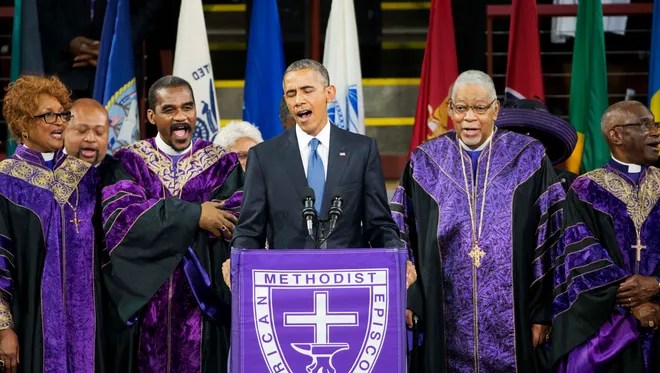
How is such tenderness possible in the face of such heartbreak? Barack Obama explained it well on Friday, June 26, at the funeral services for The Reverend Clementa Pinckney, who led the Bible study that night. In his wise and moving eulogy of the senior pastor, the President evoked a truth that rests at the heart of Christian theology. “God works in mysterious ways,” he said. “Blinded by hatred, the alleged killer could not see the grace surrounding Reverend Pinckney and that Bible study group—the light of love that shone as they opened the church doors and invited a stranger to join in their prayer circle.”

Grace. God’s love extended to the undeserving. Not earned, but given freely. Not claimed by the entitled, but accepted—humbly—by the unworthy. Not just manifested in the face of tragedy, but triggered by tragedy itself. Amazing grace. That has saved a wretch like me time and again. That compels me to be my best today and enables me tomorrow to strive for even better.

“As a nation,” said the President, “out of this terrible tragedy, God has visited grace upon us, for he has allowed us to see where we’ve been blind. He has given us the chance, where we’ve been lost, to find our best selves.  We may not have earned it, this grace, with our rancor and complacency, and short-sightedness and fear of each other—but we got it all the same. He gave it to us anyway. He’s once more given us grace. But it is up to us now to make the most of it, to receive it with gratitude, and to prove ourselves worthy of this gift.”

To do that, we must go and do likewise. We must follow the good example of the members of the Emanuel African Methodist Episcopal Church. “As I have loved you,” said Jesus, “love one another” (John 13:34). It’s what He asks of those He has loved. And it is the essence of discipleship.

PW