This Is Different

Dear Will:

I’ve lived in Southern California since I was seven years old. In those early years, we lived in Redlands, jammed up against the San Bernardino mountains, a place where all of the smog from the LA basin would gather and settle in for a nice, long retirement. During the summertime, we would play outside from morning chores to dinner until our lungs became so inflamed from the toxic air that if we tried to take a deep breath we would cough uncontrollably. Smog-lung remains a recurring, vibrant part of my childhood memories.

But you know what is not part of those memories? (I marvel even as I think of it.) Wildfires. I’m sure they were there since wildfires kind of come with the territory around here. My siblings assure me that I was not paying close enough attention. But if they had been as common as they are now, or as devastating, surely they would have left more of a mark. I would remember the smoke as I do the smog. If I had had to scoop ash out of the swimming pool, or hose down my roof, or flee with my family with only the things we could carry; if I had stood in my driveway and watched as fire raged down the mountain from Big Bear through Barton Flats toward my neighbors’ homes; if my friends had been displaced, their lives turned upside down by a raging inferno, surely I would remember that. But I don’t. This is new. This is different.

Climate scientists have been predicting for years that it would come to this. They warned us that a warmer planet would result in more intense weather phenomena. Perhaps like me you watched An Inconvenient Truth with a healthy dose of skepticism; but at the same time I remember leaving the theater and thinking: “Perhaps he is just a reactionary, but at the same time, the downside of trying to do something about this is negligible compared to the risk of doing nothing. Why wouldn’t we at least try?” Now here we are, almost 20 years later, and Al Gore looks more and more like one of those old-timey prophets who the people ridiculed and ignored. Some still do.

Here in the present, circumstances were ripe for devastation coming into this week: Two years of heavier-than-usual rainfall brought wondrous growth to our hillsides and communities, but this year we’ve had so little rain that all of that new growth has been converted to kindling. When the atmosphere churned up dry, hurricane-force winds (double the intensity of our usual Santa Anas), it was a conflagration just waiting to happen. It’s hardly worth mentioning that 2024 was the warmest year ever recorded, breaking a record that was set . . . just last year. No wonder people keep using terms like “unprecedented” and “once-in-a-lifetime” to describe phenomena that are now occurring every year or so.

We Californians are not alone in our suffering. Around here, drought and fires are our thing. In the Southeast, it’s hurricanes and flooding, which year after year have become more frequent and more intense. Further north, they’re into “bomb cyclones” and the polar vortex. Everywhere it’s something. But what you won’t find is anyone who will claim that things were worse when they were a kid. If you find that guy anywhere other than some cable news rantfest, send him my way because I would like to check his alternative facts.

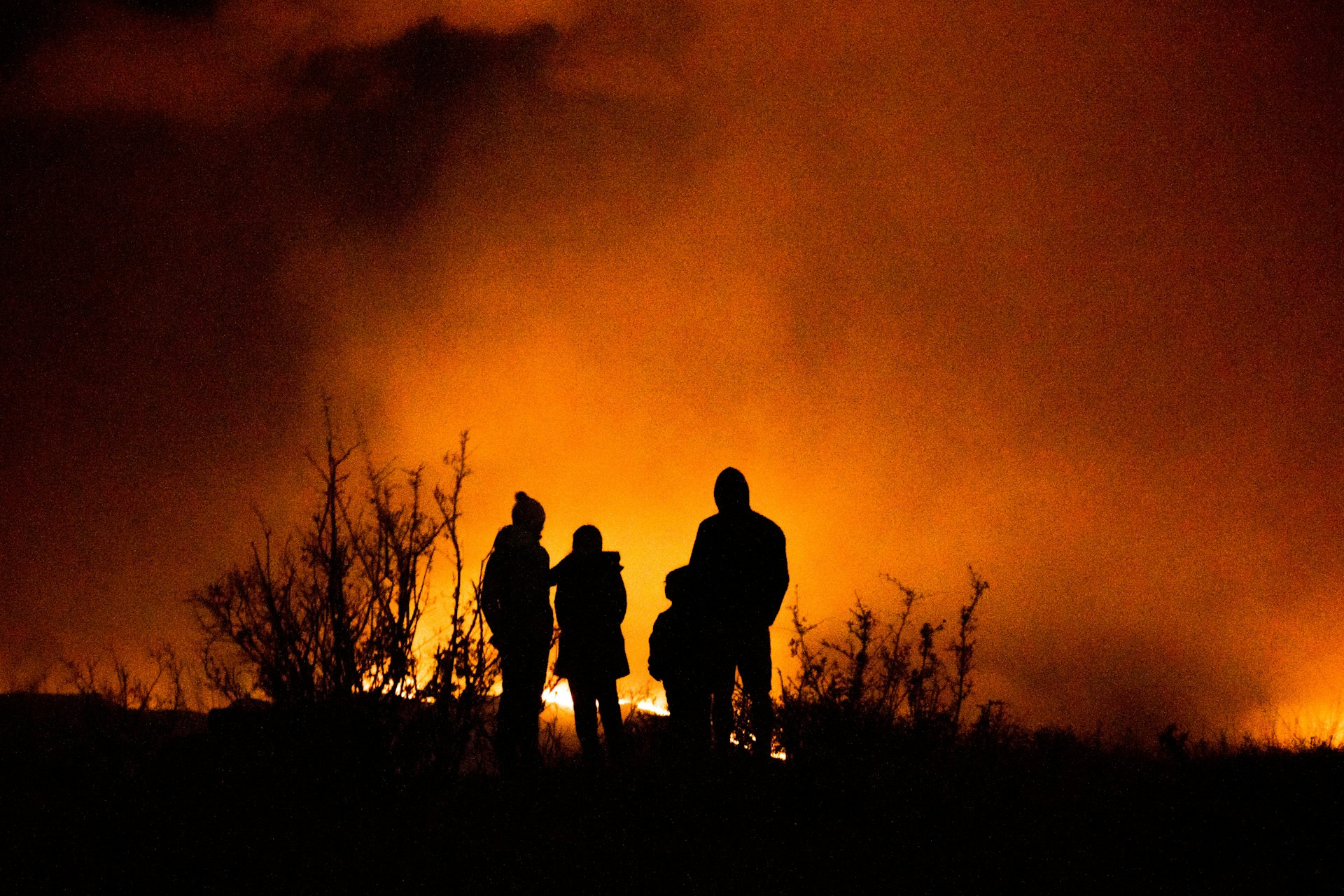
Meanwhile, this week it’s fires. Hundreds of people from Pacific Palisades to Riverside have lost their houses and probably most all of their possessions. I have friends and co-workers who have been evacuated from their homes and are spending tonight on a friend’s sofa or perhaps curled up on a cot in the local (but not too local) gymnasium. Just a block from my house, my neighbors remain without power going into a third straight day. 

Tonight Dana and I took Nacho for a walk through the streets of that darkened neighborhood. In a few places we could hear the chug-chug-chug of a generator doing its best to keep the cold cuts cold, but mostly it was just eerie and desolate—almost like a ghost town. Later, as we rounded the corner toward home, we saw other neighbors from a couple of streets over, heading into the home across the street to recharge their devices. In difficult times, it’s easy to find someone else who is willing to help out in whatever way they can.

You know what is not helpful, however? Pretending that what we can see with our own eyes is not actually happening—that it has ever been thus. It hasn’t. I know. I live here.

I hope, in spite of all of this, you are well. Please stay safe.

PW

Photo by Caleb Cook on Unsplash

Feeling a Little Down in the Mouth

Dear Will:

Dana and I were headed to Italy—not right that moment, but in a few days—when it occurred to me that maybe I ought to have a dentist take a look at this weird bump in my mouth—you know, in case it was something. It was, the dentist told me, and recommended an excellent endodontist who could probably do a root canal before I boarded the plane for Naples.

The endodontist was excellent—enough to recognize that I did not need a root canal after all. “A root canal won’t do you any good,” she told me. “That tooth has got to come out. But I can recommend an excellent periodontist.” (Which, I guess, is not the same as an endodontist, neither of which is a just-plain-dentist even though they all went to dental school. How are we supposed to keep up with this stuff?)

Isn’t it funny how we all talk like root canals are the epitome of horrible when all along there is something actually worse? Have the idiom writers never been to the periodontist? It’s like they’re not even trying! I did not know it was possible for “You don’t need a root canal” to be bad news.  Someone should tell you these things.

Just so you know—in case you have a weird bump in your mouth, for instance—when they tell you the molar has got to go, you may then find yourself having another conversation you may never have anticipated. It goes something like this:

“So, you have a couple of options. We can just pull it out and leave a gap at the back of your mouth. Eventually the bone and skin will just grow over the hole. But if you do nothing, over time your upper molar will gradually descend from the gum to fill the gap. Eventually it could start to create problems of its own.”

Having not attended dental school, I have no idea if that’s actually true or even if what I just shared with you is an accurate reflection of what the periodontist said. But it is certainly what I heard. So rather than going with the eventual out-of-control, mega-molar super-fang, I opted for one of those ultra-glam implants everyone’s talking about. Or should be, anyway. Did you know that a dental implant involves both discarded cow bones and cadaver skin? Think about that next time you’re about to kiss Grandpa goodnight.

So yeah, this is the new me, partway through a dental implant procedure with a gaping hole in the back of my maw. And although I’m sure I’ve already over-shared, I feel I would be remiss if I stopped here without sharing one last thing.

All of this pain and suffering naturally got me thinking about the most recent election. (Didn’t see that coming, did you? And now you can’t even say, “Do we have to talk about this? I’d rather have a root canal!”—because I’ve ruined that idiom for you forever. Ha!)

So anyway, politics. Regardless of how you voted, perhaps like me you are mystified that over half the country disagrees with you, that even though the choice this time around was so obvious, more than half of your fellow Americans either believe you got it wrong or don’t care enough to pay attention. How is that possible?, you might wonder. It should not even be close! Everyone has access to the same information, and yet we come to totally different conclusions. No wonder we often find it hard to co-exist.

And yet, we must. “There must be opposition in all things,” the scripture says—and that’s not just a philosophical observation. Opposition—I recently learned while someone was jamming sharp instruments dangerously close to my uvula—may be the only thing keeping us from growing even uglier and more crooked than we already are. Pushback is not only a good thing—it’s vital to the whole operation.

I can’t tell if this not-very-profound thought is my attempt to make myself feel better about the pain I’ve been suffering, but I have found it helpful perspective as I ponder the future—of both my mouth and my country.

Go ahead and spit.

PW

Like Coming Home

Dear Will:

Dana and I were about 10 days into a two-week trip through Italy, with rain threatening to ruin our second day in Cinque Terre. Improvising, we decided to take an unscheduled side-trip to Porto Venere, a small hamlet set on a finger of land poking out into the Mediterranean. Along with its more-famous neighbors that make up the “five lands” of Cinque Terre, Porto Venere has been declared a UNESCO World Heritage Site. There are islands nearby and some old buildings. That’s about all we knew. 

Following a 45-minute train ride, a 15-minute slosh to the bus stop (got lost a couple of times), and a 35-minute ride on a local bus, Dana and I looked around and found that there wasn’t a whole lot going on in Porto Venere. But unlike the villages of Cinque Terre we had visited the previous day, Porto Venere was not overrun by tourists sent ashore from a nearby cruise ship. We loved it immediately. 

We made our way to the old church perched on a rocky outcropping at the edge of town. The Church of St. Peter, we learned, had been consecrated in 1198 (!). It’s a simple edifice, with a plain stone interior almost devoid of ornamentation. The main sanctuary contains simple pews and but one crucifix, and that cloudy day it was dimly lit only by natural light and a few candles left by previous visitors. Music from a single harp floated through its barren walls. It was so quiet and peaceful inside that small chapel that we were enveloped with a sense of reverence. I knew in an instant I had found the church where I would want to worship if I were a local Roman Catholic.

If you’ve spent time in Italy, you might find that a curious choice. During our visit we saw (along with hundreds of others) some of the most famous, magnificent spiritual sanctuaries in the world: the Florence Cathedral, with all of its gothic opulence; the massive St. Peter’s Basilica at the Vatican; the Sistine Chapel, the beauty of which is overwhelming; not to mention several other less-famous but also impressive churches that seem to arise on every corner of every town in Italy. All were beautiful and awe-inspiring, but for all their grandeur and artistry, none of them made me feel connected to God like that small church atop the rocks in Porto Venere. Entering the Church of St. Peter—away from the crowds and the spectacle—was like coming home.

The experience brought to mind a story told by Elder Robert E. Wells in which he describes the embarrassment he felt as a missionary bringing a sophisticated, cultured, well-educated woman to church for the first time. The services were held in an old building under the direction of inexperienced local volunteers. It was a bit of a sloppy mess from start to finish:

On the way home, one of the missionaries began to reflect his embarrassment. He explained: “Please excuse our present building. Some day we will build a lovely new chapel here.” Then he added: “Please excuse our new leaders. We have a lay priesthood, so we take turns conducting, and the new leaders are still learning how to conduct services.” He was just about to give another excuse when Sister Herta Mellor turned to him and said somewhat sternly: “Elder, don’t you apologize! It must have been like this at the time of Christ!”

When I heard that talk (in Spanish), delivered in Elder Wells’ signature baritone, it spoke to my heart. I myself was a missionary—serving at the time in Barrio 15, a small unit of our church near downtown Montevideo, Uruguay. Our tiny congregation met each week in a small, four-room building across the street from a cemetery. In that makeshift chapel we had to rearrange the furniture between meetings. It had broken glass and a wall that was slowly crumbling. Its roof leaked with enthusiasm any time it rained. But, oh! how I loved Barrio 15.

The people of that congregation were humble, faithful, and full of love—unimpressive, and yet the very embodiment of what you might refer to as “the pure love of Christ.” Though I was a foreigner, they embraced me (often literally) as one of their own, showering me with so much love and affection that I would happily have remained in Barrio 15 for the full length of my two-year mission. When it came time for me to move on to my next assignment, I rose before the congregation to say good-bye, but words failed. I stood, I stammered, and then I sobbed like a baby.

So yes, I know something of humble sanctuaries. Thus, when Dana and I discovered the busker whose harp accompanied our visit to the Church of St. Peter, we gladly added a few coins to his hat. To thank him for speaking to our hearts. For helping us connect memories and emotions across the years. For filling us once again with the love of God.

PW

Interior Sanctuary Image: © Achim Tomae/Getty Images