
By This Shall All Men Know

Dear Will:

I sat yesterday in a Sunday School class with the finest people I know. Our text was John 13 (just following the Last Supper) wherein Jesus washes the feet of His apostles and utters these defining words of Christendom: “By this shall all men know that ye are my disciples, if ye have love one to another” (John 13:35). He was saying, in essence, that the best way to tell who His true followers are is to watch how they treat others.

The scene there in the Santiago Creek Ward could not have been significantly different from the one you might have seen on the evening of June 17, at the Emanuel African Methodist Episcopal Church in downtown Charleston, South Carolina. That is, until things became entirely different. About an hour into the Bible study that night, a visitor pulled out a gun and shot ten of the worshipers, leaving nine of them dead. The misguided ideas which drove him to that hateful act remain in stark contrast to the message of love inherent in the book they studied together that night.

Two days after the murders, survivors and relatives of some of the victims gathered at a legal hearing to confront the accused killer. But rather than releasing the full force of the anger and pain which surely they feel, they took the opportunity to extend forgiveness to the man apparently responsible for the deaths of their loved ones. To those who are not believers, what transpired at that hearing may have been entirely unexpected. But to those who have embraced the teachings of Jesus, they should not be. Remarkable still. Truly remarkable. But not unexpected at all.

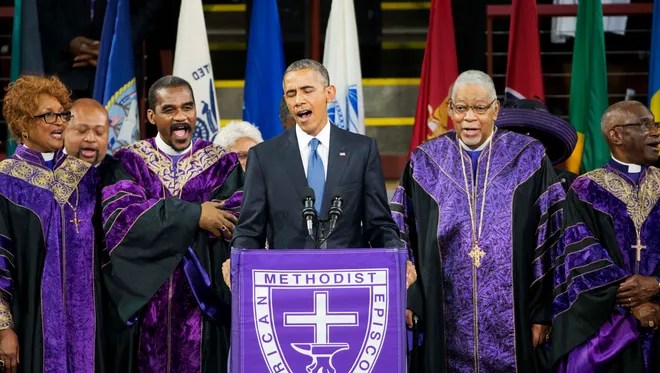
How is such tenderness possible in the face of such heartbreak? Barack Obama explained it well on Friday, June 26, at the funeral services for The Reverend Clementa Pinckney, who led the Bible study that night. In his wise and moving eulogy of the senior pastor, the President evoked a truth that rests at the heart of Christian theology. “God works in mysterious ways,” he said. “Blinded by hatred, the alleged killer could not see the grace surrounding Reverend Pinckney and that Bible study group—the light of love that shone as they opened the church doors and invited a stranger to join in their prayer circle.”

Grace. God’s love extended to the undeserving. Not earned, but given freely. Not claimed by the entitled, but accepted—humbly—by the unworthy. Not just manifested in the face of tragedy, but triggered by tragedy itself. Amazing grace. That has saved a wretch like me time and again. That compels me to be my best today and enables me tomorrow to strive for even better.

“As a nation,” said the President, “out of this terrible tragedy, God has visited grace upon us, for he has allowed us to see where we’ve been blind. He has given us the chance, where we’ve been lost, to find our best selves.  We may not have earned it, this grace, with our rancor and complacency, and short-sightedness and fear of each other—but we got it all the same. He gave it to us anyway. He’s once more given us grace. But it is up to us now to make the most of it, to receive it with gratitude, and to prove ourselves worthy of this gift.”

To do that, we must go and do likewise. We must follow the good example of the members of the Emanuel African Methodist Episcopal Church. “As I have loved you,” said Jesus, “love one another” (John 13:34). It’s what He asks of those He has loved. And it is the essence of discipleship.

PW

My Fast Solution to the Drought

Dear Will:

If you drive east on Katella Avenue toward Orange Park Acres and the canyons beyond, you come to large dip in the road where it crosses the recharge basin for Santiago Creek. I’ve always assumed that scoop in the road to be a sort of flood control precaution—you know, should the creek swell and overwhelm the surrounding cavity.

As if. The water level in the basin has been so low for so long that the thought of flooding would be laughable if the situation weren’t so sad. Because of that near-empty hollow, I have come to dread that eastbound drive toward my home. It has become an almost-daily reminder of the prolonged drought which prompted California Governor Jerry Brown to declare a State of Emergency in January. How bad is it? They say that this drought (four years old and counting) is the worst in over 100 years. Snow packs are disappearing. Lakes and reservoirs are shrinking. Farms are lying fallow. The drought even has its own website. And its own logo.

State of California Drought Portal Logo

And now that the governor has imposed restrictions on how often and how long we can run our sprinklers, my lawn, along with countless others, has begun what promises to be a slow, brown death.

I suppose it’s only fair. They say that not watering my lawn is the single best way for me to contribute to the conservation effort; so OK, I’ll do my part. But as I look out on the thirsty landscape and ponder the seeming impossibility of reversing years of irresponsible environmental practices and unchecked modern living, I can’t help but hope for some Divine Intervention—that God, in His infinite mercy, will bless us far beyond our merit and call down steady, prolonged rains upon our parched and withering state.

But how in the world could we actually make that petition? Elijah ended a drought single-handedly, but then again, it was a drought of his own making (see 1 Kings 17 and 18)—plus he had the benefit of the sealing power. I lack both the power and the panache of that guy. What could I or any of us do to call down the powers of heaven from our relatively powerless and obscure positions?

The short answer: I’m not sure. But I do have one idea worth trying. Isaiah taught that if we observe a true fast, setting aside our own physical needs to share with those less fortunate, the blessings are numerous—including this one: “And the LORD shall guide thee continually, and satisfy thy soul in drought, and make fat thy bones: and thou shalt be like a watered garden, and like a spring of water, whose waters fail not” (Isaiah 58:11).

I realize, of course, that in his typically metaphorical prose, Isaiah was likely not referring to a literal drought. But why not? We are not far from the day in which the dry land will begin to have a desiccating impact on our souls as well. What’s more, I can’t think of a more worthy appeal to make during a prayerful fast, especially as we allow that period of physical deprivation to cause our hearts to go out to those around us who suffer from want. In fact, Isaiah says that one of the other blessings of a heartfelt fast is this: “Then shalt thou call, and the LORD shall answer; thou shalt cry, and he shall say, Here I am” (Isaiah 58:9).

So here’s my plan: Beginning next Sunday (June 7), and on the first Sunday of every month hereafter, I intend to put Isaiah to the test. I will abstain from food and water for 24 hours. I will contribute what I might have spent on food that day (and then some) as an offering to assist the needy. And between now and then, I will plead to God for rain—and lots of it. I’m not so arrogant as to think that my humble prayers will be sufficient to solve a four-year drought, but if I could get you—and many others like you—to join me in this effort, who knows?  I think it’s certainly worth a try.

So what do you say? Are you with me?

PW

First Things First

Dear Will:

Ever find yourself going in so many directions at once that you can’t concentrate very long on any one thing? I don’t know about you, but when I get into that sort of synapse-firing frenzy, it’s almost paralyzing. My mind becomes a jumble. At best I’m inefficient with how I use my time; at worst I get nothing done whatsoever.

It wasn’t very many years ago that I was a devotee of the Franklin Planner, a system for organizing one’s day and getting stuff done. I first encountered the Franklin Planner in the mid-‘80s when I served a short, ill-fated stint as Stake Clerk  in the Los Angeles Stake. The men in that Stake Presidency were very accomplished and successful, and all three of them swore by the Franklin Planner. As an unaccomplished and unsuccessful 20-something wannabe, I was in no position to judge, but since I was a 20-something wannabe it didn’t stop me. I teased and taunted them about their devotion until, a few years later, I sheepishly got a Franklin Planner of my own.

In those days, when you bought your Franklin Planner starter kit they encouraged you to listen to a couple of cassette tapes designed to train you on how to use the planner and to motivate you to actually use it. Central to the approach was the “Prioritized Daily Task List” in which you were supposed to separate the important from the not-so-important so that you would be less likely to burn time and energy on low priority fluff and more likely to focus on the truly essential. It’s what Stephen R. Covey has referred to as “putting first things first.”

So which things should come first? The answer to that question will vary from day to day, but over the long arc of time, that which matters most will always have more to do with human relationships than with personal achievement or financial success. Our prophet, Thomas S. Monson has said:

I believe that among the greatest lessons we are to learn in this short sojourn upon the earth are lessons that help us distinguish between what is important and what is not. . . .

[And] what is most important almost always involves the people around us. Often we assume that they must know how much we love them. But we should never assume; we should let them know. Wrote William Shakespeare, “They do not love that do not show their love.” We will never regret the kind words spoken or the affection shown. Rather, our regrets will come if such things are omitted from our relationships with those who mean the most to us.

Send that note to the friend you’ve been neglecting; give your child a hug; give your parents a hug; say “I love you” more; always express your thanks. Never let a problem to be solved become more important than a person to be loved. (“Finding Joy in the Journey,” General Conference, October 2008)

It’s an important reminder, especially as I consider the scribbled list before me: so many self-centered to-do’s that there’s hardly room for a person to get my attention. Perhaps it’s time for me to reprioritize.

It’s a speech I have given myself before—and certainly one I will give myself again—but for now, my mind is a little less jumbled. So before I post this letter, I think I’m going to go call my mom.

PW