
Over Par for Life

Dear Will:

When I was around 16 years old, I had a life-changing experience while strolling down the fairway at the Glendora Country Club. It was summertime, and I was golfing with friends—Tim Patterson probably, perhaps Jeff Salter or Mike Daly or maybe Brian Regele. I was in the midst of a typical round of exasperating, worse-than-bogie golf. After chunking another short iron and slamming my club to the ground in frustration, I had a great epiphany—as if angelic choirs were singing a hymn composed for me and me alone. You will never be any good at this game, the cherubim seemed to intone. Amen and amen.

Even so, I’ve always liked golf—still do. But I’m terrible at it in ways that the word terrible fails to adequately express. I could spend thousands on lessons and equipment and greens fees, quit my job and devote myself to the game full time, but I would remain, at best, a mediocre golfer, one who knows that over par is the best he should ever reasonably hope for. Anything better than that, on any single hole on any single day, is not just an aberration but a fluke of miraculous proportions.

I was pondering all of this the other day while hacking my way around a course with some friends from work. I had five bogies and four worse-then-bogies in nine holes on a relatively easy golf course. Final score: many, many strokes more than allowed, significantly  and emphatically over par. As always. Forever. Just like my life, I thought.

At which point the choirs sang again.

Over Par for Life—the only standard I consistently live up to. If I had a personal website, down by my logo you might find the tagline: “Falling Short Since 1968.” Good intentions I have down cold. Successful follow-through, on the other hand? Not so much. In theory, I’m a terrific husband and father, a dedicated employee, an unselfish, generous, kindhearted soul who is unflappable in the face of trouble and impervious to stress. In practice, however,  I’m as proud as the next guy, self-serving and self-righteous, low on patience and cranky when it suits me. Plus I’m way too quick to raise my voice. Way.

Consequently, this is not one of my favorite scriptures: “What manner of men ought ye to be?” Jesus asked.  “Verily I say unto you, even as I am” (3 Nephi 27:27). I think that pretty much means that I’m supposed to be nice to everyone all the time, control my temper, think of others first, give until I have nothing left to give. I’m supposed to uphold all 12 of the principles in the Scout Law and live the Young Women’s Values at the same time.  Be totally other than I am, in other words.

You will never be any good at this game. Amen and amen.

And yet, even for a perpetual duffer like me, there remains not just a glimmer of hope, but an incandescent hope so bright that it cannot be ignored. The whole reason Jesus came to this earth in the first place was to make a way for us, in spite of our imperfections, to reconcile ourselves with God.  “If men come unto me I will show unto them their weakness,” the Lord has said.  “I give unto men weakness that they may be humble; and my grace is sufficient for all men that humble themselves before me; for if they humble themselves before me, and have faith in me, then will I make weak things become strong unto them” (Ether 12:27).

So there you have it: a fighting chance for all of us who perpetually fail to measure up. Over Par for Life, perhaps, but His grace is sufficient to make up the difference. Sufficient. Enough. Even for a hacker like me.

Now if only I could get that promise to apply to my golf game. That would be truly something.

PW

Photo by Peter Drew on Unsplash
Not Out of Place at All

Abyssinian-Sunday-Service-800px

Dear Will:

If you had stopped every pedestrian on Broadway you could not have found a single person who would have sized us up and declared that we fit in. We were out of place, out of our element, clearly from out of town. Although we didn’t get lost as often as we did the last time we visited Bryn in New York, we still stood out in all of the ways you don’t want to.

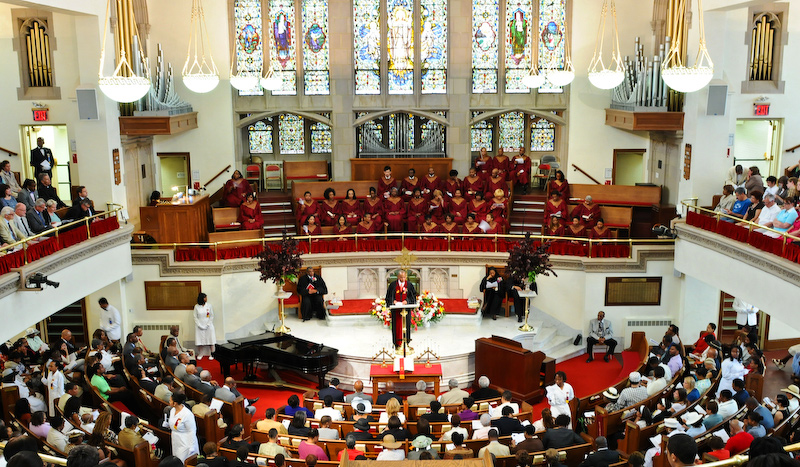
Then on Sunday, it seemed to get worse. Following up on something we had read, we decided to attend church in Harlem. We took the subway from our hotel on the Upper West Side and walked a short distance to the chapel. We had arrived over an hour early, so you can imagine our dismay when we saw the line of visitors stretching down the block and around the corner. And it was raining.

Feeling ill-at-ease and bracing for a drenching, I asked one of the men in charge of crowd-control if this was indeed the line for the Abyssinian Baptist Church. What happened next was astonishing. “Are you from out of town?” he asked, as if it weren’t embarrassingly obvious to everyone in the tri-state area. When I confessed that we were, he led us past the long line of tourists and, without explanation, ushered us to the main entrance reserved for local members. Within a few more minutes, we were inside, huddled in the vestibule with a handful of the faithful, waiting for the 11 a.m. service to begin.

We were dumbfounded. With dozens waiting outside in the rain for the chance to sit with other visitors in the balcony, why had he escorted us to this preferred location? Before long, we were invited to enter the main sanctuary where we took our places among the regular congregants. We sat there admiring the setting while feeling (I admit) the sort of self-consciousness that comes from being an Orange County Mormon sitting in the wrong pew in a Harlem Baptist church.

Even so, the members of that church could not have been more gracious. We heard beautiful, rousing music from an enthusiastic choir. There was an appropriately reverent interlude in which all were invited to partake of bread and wine in remembrance of the sacrifice of Jesus on behalf of sinners everywhere. The pastor gave an outstanding sermon—a passionate reminder of something the choir had sung earlier: that although God does not always come when we ask, He always comes on time. As Abraham learned on the mount, he told us, the Lord will definitely provide. Affirmations of faith and testimony reverberated throughout the sanctuary, and I found myself reflecting on the ways in which God has consistently been there for me when I need Him most.

As expected, the Baptists did things a little differently than we are accustomed to, but we enjoyed the service nonetheless. Near the end of the two-and-a-half hour meeting, the members around us turned and warmly shook our hands—a simple but fitting gesture of welcome. It truly felt as if our common bond of faith in Christ had at last made us “no more strangers and foreigners, but fellowcitizens with the saints, and of the household of God” (Ephesians 2:19).  We were far from home, in someone else’s church, but in that moment, anyway, we didn’t feel out of place at all.

The following Sunday we were glad to be back in California, sitting at ease in our own Santiago Creek Ward chapel. It felt good to be caught up in the warm embrace of familiarity, surrounded by the finest people we know—people who have made us feel like family since the day we first arrived in Orange over 15 years ago. We were delighted to be home where we truly do belong, worshiping God together with others who share our faith and beliefs. As I sat there enjoying a wonderful service, I was once again reminded of what Jesus Himself had taught: “For where two or three are gathered together in my name, there am I in the midst of them” (Matthew 18:20). Which is, of course, why we gather. And why your life would be blessed, as mine has been, should you one day choose to gather with us. I’ll be there to make sure you get a good seat.

PW

Tending Our Nest

Dear Will:

Every March or April for the past I-don’t-know-how-many, birds have taken up residence in the eaves above our front door. They have treated the nest there like a vacation home, abandoning it as summer approaches and then returning the following year in early spring. Their return always involves some basic home improvement and busy-ness, signaled by random twigs discarded on the welcome mat outside our front door. A couple of years ago we even saw a second nest appear maybe three feet from the original, transforming our porch into a bustling housing tract. We were delighted.

Then last summer we felt compelled to repaint the exterior of our home. In preparing for their work, the painters cleaned the eaves around the full perimeter of the house, discarding (I’m sad to say) the abandoned nests in the process. We wondered if we would ever see our birds again.

So you can imagine our delight a few weeks ago when twigs began appearing outside our front door once again. In no time the vacation home had been reconstructed, and before long we began hearing the familiar sound of hungry baby birds.

To satisfy our curiosity without agitating the mother and her babies, we sometimes stand inside our home and sneak a peek through the window at the young family that lives in “our nest.” Although we do not have the well-placed camera you get on a National Geographic Special, if you’re patient you can stand just a few feet away and see the tiny heads poking out and calling for supper. You’ll also see the mother, coming and going, coming and going, tending to the needs of the tiny birds in her care.

All too soon the little brood will be gone.  Somewhere nearby, our baby birds may stand chirping in a tree or may bounce along the grass foraging for food. Perhaps they will join many others at the birdfeeder in our backyard, or perhaps they will depart, never to return. I suppose it’s even possible that one of them will find a mate and return to the nest beneath the eaves. I don’t really know how it is with birds. But this I do know: For now those fragile lives are almost entirely dependent on the vigilant care of their mother. She will nurse them and feed them, guard them and teach them, prepare them as best she can and then step aside and watch—I imagine with some anxiousness— as they head off to find their way in the world beyond the protection of our eaves.

Inside our home, it has ever been thus. My wife has nursed and fed and guarded and taught, worrying and praying and willing our children from infancy to adulthood. Now she stands aside, watching from afar, as two of our three have left the nest and are trying mightily to take flight in the perilous world beyond our doors. There is little more that she can do at this point, but it does not keep her from worrying night and day about their welfare. It would not surprise me if, even as I write these lines, she is kneeling again at her bedside, beseeching her Heavenly Father to watch over her precious little ones.

I know this also: The love poured out by that kneeling woman is unwavering, heartfelt, as powerful as any emotional force in the universe.  As Dana watches her children take those first tentative steps of adulthood, she feels every misstep, shares every heartache, celebrates every success, and thrills at every opportunity to watch her children rise and answer the challenges of real life. This does not make her unique; it makes her a mother.

Thank God for her, and for those like her, and for the children they continue to bless with their unrelenting love.

PW