
How What We Should Be Becomes What We Are

the-list

Dear Will:

From what I can recall, Jesus has wanted me to be a sun-BEAM pretty much my entire life. So I couldn’t possibly tell you when I was first admonished to say my prayers, read my scriptures, and go to church, but that particular set of mandates was already so familiar by the time I reached high school that my friends and I referred to it simply as The List. If a teacher in Sunday School asked a question and you weren’t sure of the answer, it was a pretty safe bet that you could pluck something off of The List and get it right more than half the time.

Say your prayers. Read your scriptures. Go to church. These simple injunctions have been drilled into me by teacher after teacher, week after week, throughout the course of my life. If Sunday School were the sort of institution that required a proficiency exam for graduation, you can bet The List would be featured prominently on the final:

17. How can you show Jesus that you love Him?

A.  Say your prayers
B.  Read your scriptures
C.  Go to church
D.  All of the above

In spite of my youthful cynicism, over the years I have come to appreciate the personal benefit to be derived from daily devotional practice. And something I read recently caused me to consider The List in an even brighter light.

In his book, Predictably Irrational, Dan Ariely, an economics professor at Duke University, describes a two-step experiment he completed several years ago with a couple of colleagues. They asked those in Group A to write down 10 books they had read in high school and those in Group B to write down the Ten Commandments. Then they gave the two groups identical sets of simple math problems, rewarding them with cash for each problem they claimed to have solved in the allotted time. When they compared the results from the two groups, they discovered a curious difference. On average, Group A overstated their success rate by 33%, while Group B reported their results honestly, without exaggeration.

In another experiment, Ariely gave two groups of people different word-search puzzles: one with words related to rudeness and the other with words related to patience. During Phase 2 of the experiment, the “rudeness” group proved to be significantly more impolite than the “patience” group.

Isn’t it interesting that simply being reminded of virtue seems to have a measurable impact on behavior? Doesn’t it make sense, then, that God would want us praying and reading and attending services on a regular basis? At the risk of reading too much into this, we might even hypothesize that faithful Christians are enticed to become better people at least in part by their ongoing exposure to the Word. By regularly reminding ourselves of what we should be, what we should be becomes what we are.

Seems like I read that someplace—perhaps during my daily scripture study, maybe during a Sunday School class. Ah, yes. Here it is in The Book of Mormon: “The preaching of the word had a great tendency to lead the people to do that which was just—yea, it had had more powerful effect upon the minds of the people than the sword, or anything else, which had happened unto them. . .“ (Alma 31:5).

What are some things we can do to become better people? Go ahead. Guess. There’s a pretty good chance you’ll get it right.

PW
The Wonders of Being a Kid

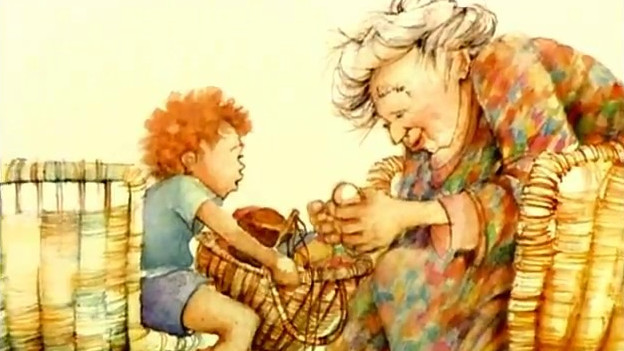
Wilfrid Gordon with Miss Nancy
Illustration by Julie Vivas

Dear Will:

When I was three years old, my family moved from Billings, Montana (my birthplace) to Las Vegas, Nevada, where we lived until I was seven. Because I was so young during those Vegas years, I retain only a random collection of memories of the place, many of which are of such arbitrary variety that you have to wonder how they managed to find residence in my cerebral cortex. For instance: In my bedroom I had what I referred to as my “treasure drawer” in which I maintained a cache of precious possessions, including the one item which I still recall to this day: a worn-out, pink tennis ball. I can’t recall what I ever did with that ball, but as I close my eyes and mentally open that drawer to peek inside, there it is.

Other memories are equally bemusing, having become, over time, my personal Norman Rockwell gallery from that era: Climbing a tree in the front yard to fire a peashooter at unsuspecting pedestrians. Lying down directly on the hot pavement beside the swimming pool to dry out in the sun. Bending to examine an anthill on my way to John S. Park Elementary School. I can’t recall the dining room in that home where (I assume) I ate every meal for four years, but somehow I remember playing with a kid down the street who had this board game based on that old Allan Sherman song “Camp Granada.” The kid’s name? I have no idea. But his parents were totally into Sonny and Cher.

Our home in Las Vegas was on South 15th Street, directly across from an undeveloped patch of dirt we referred to as The Vacant Lot, where I recall booting around an old leather football with the kind of laces that today you find only on an old pair of Converse All-Stars. I would hold that ball sideways, with a point in each hand, and punt it skyward again and again. My technique was flawed, I discovered years later, but as first-grade punters go, I was exceptional. Or at least that’s how I remember it.

What am I to make of these odds and ends of childhood, assembled as it were in the treasure drawer of my mind? As memories go, not one is of any historical significance. But as time has slipped ceaselessly onward, they have become finger-holds that allow me to hang on tenuously to a part of me that would otherwise be lost.

This brings to mind a favorite children’s book by Mem Fox about “a small boy called Wilfrid Gordon McDonald Partridge, and what’s more he wasn’t very old either.” He lives next door to an old folk’s home and befriends its residents, but his favorite person of all is Miss Nancy Alison Delacourt Cooper “because she had four names just as he did.” When Wilfrid Gordon learns that Miss Nancy has lost her memory, he gathers up some of his own treasures in a basket to share with her.

“What a dear, strange child to bring me all these wonderful things,” thought Miss Nancy. Then she started to remember.

She held the warm egg and told Wilfrid Gordon about the tiny speckled blue eggs she had once found in a bird’s nest in her aunt’s garden.

She put a shell to her ear and remembered going to the beach by tram long ago and how hot she had felt in her button-up boots. . . .

She smiled at the puppet on strings and remembered the one she had shown to her sister, and how she had laughed with a mouth full of porridge. . . .

And the two of them smiled and smiled because Miss Nancy’s memory had been found again by a small boy, who wasn’t very old either.

No doubt the day will come when my memory will be lost, just like Miss Nancy’s. But who knows? Perhaps when that happens, a grandchild will climb up into my lap to show me a worn ball she found in an empty lot near her home, and unawares it will catch me and carry me back to South 15th Street. Meanwhile, I hope to keep the original tennis ball, pink and scuffed, for as long as I can, tucked away in the treasure drawer of memory, a precious reminder of the wonders of being a kid.

PW

Hope, Prayer, and a Whole Lot of Duct Tape

Busted Boots

Dear Will:

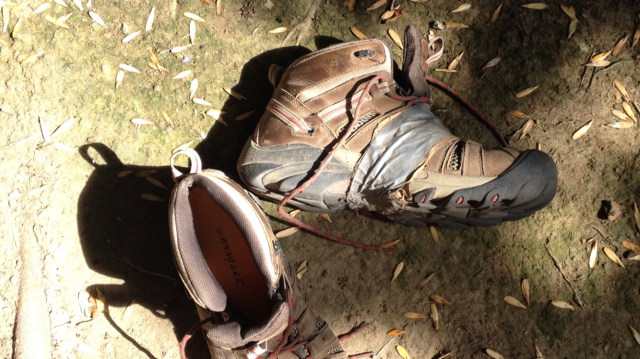
We were over 20 miles into a 50+ mile backpacking trip though the Golden Trout Wilderness in the High Sierras. With 35-40 pounds on our backs, we had completed the long, relentless slog up and over New Army Pass (12,300 feet) the day before, and somewhere on the backside of Guyot Pass (10,958 feet) my son, Seth, alerted me to a problem. My boot was coming apart.

I stared in disbelief. Clearly, the sole was detaching itself from the body of the boot, which seemed, upon reflection, sub-optimal to my purpose. I had come to climb Mt. Whitney—at 14,505 feet the highest peak in the contiguous United States—and the thought of doing so with half a left boot was untenable. As we tromped on, I kept rechecking the evidence (the way we do), as if on the fifth or eighth or tenth look I might discover that the previous nine had been an illusion. But a couple of dozen rechecks changed nothing. My foot was kaput.

When we set up camp in Upper Crabtree Meadow that evening, I considered my options, but not for long. The next day was Whitney, an all-day, 15-mile roundtrip requiring a 4,000-foot ascent, after which we would still be over 20 miles and three more mountain passes away from the trailhead. The manifest virtues of duct tape and hope (in that order) notwithstanding, the moment for prudence had clearly arrived. I tried to imagine it: Local Hiker Bags Whitney But Loses His Sole. With the welfare and safety of others directly affected by my actions, I just couldn’t take that chance.

There were 19 of us in total, six adults in various stages of middle-aged “fitness” along with 13 boys from 14 to 18 years old. I was by no means the leader of this expedition (outdoor competence being a necessary prerequisite), but I did feel responsible in a kind of paternal, ecclesiastical sense. And then of course there was Seth. Ten years ago I climbed Whitney with my oldest son, Luke, and while I can’t say that I relished the anticipation of the lung-shrinking climb to the summit, I did look forward to that trophy-shot of the two of us, hands on one another’s shoulders, the Sierra mountains stretching out behind us like a giant’s gnarled molars and bicuspids. Alas, it was not to be.

So the next morning the others began their climb to glory while I stayed behind supervising our campsite. I paced. I fidgeted. I fidgeted and paced. Anxiousness turned to worry as I tried to imagine my little group of intrepid alpinists. I knew, for example, that there are lightning showers every afternoon on Whitney, and if you don’t get off of the summit in time you may unwittingly become a Ben Franklin experiment. So you can imagine my state of mind as the hours passed and the afternoon rains came and my climbers were nowhere in sight. I quickly stowed our gear inside the tents, and then, with no other recourse available, I stowed myself inside as well, feeling helpless and useless as I imagined how I might report my experience later. (“How was your trip?” “In tents.”)

Seven hours. Eight hours. Nine hours passed. I lay in my tent, listening to the steady thrump of rain and praying for the safe return of my companions. Of my son. Finally, ten hours after their departure I heard the first voices. They straggled into camp, bedraggled and exhausted. Finally, over 11 hours after their 7am departure, the last of our group stumbled into camp.  I felt a surge of emotion that surprised me. We were safe. Together. At last.

I do not wish to overstate the significance of this experience for me. But I can tell you truthfully that what I felt that afternoon is not that different from the longing for togetherness—for homecoming—that I feel for you and every other member of the Santiago Creek Ward. I wait. Hoping to hear your voice. Praying for your safe return.

PW